Reckless driving in Colorado means driving with wanton or willful disregard for safety under C.R.S. § 42-4-1401. It is a class 2 misdemeanor, so fines and jail time are possible, and a conviction adds 8 points to your license record. Don’t plead or pay before you understand your options.
TL;DR:
- Adults face possible suspension at 12 points within 12 months, so another moving violation after a conviction can put a license at risk.
- The DMV handles license consequences separately from criminal court and uses a lower burden of proof, so a favorable court result does not secure your license.
- Class 2 offenses and cases involving accidents go before a judge, so track court dates and get advice before paying or entering a plea.
- Prosecutors may infer intent from speed, road conditions, and driving choices, but video, witness accounts, and speed equipment can be challenged for errors.
- Repeat convictions can bring fines up to $1,000 and jail up to six months; injuries or serious property damage may change the charges.
Table of Contents
- How does Colorado define reckless driving under C.R.S. § 42-4-1401?
- What penalties can you face for a reckless driving conviction?
- How do DMV points and administrative actions affect your license?
- What happens after you receive a reckless driving citation?
- What conduct and evidence lead to reckless driving charges?
- How can you defend against or reduce a reckless driving charge?
- What should you do right after being cited?
- What a former prosecutor sees that most drivers miss
- How we help with a reckless driving charge in Colorado
- FAQ
- Sources
How does Colorado define reckless driving under C.R.S. § 42-4-1401?
The statute is short, and the standard it sets is higher than most drivers expect. Colorado law says a person commits reckless driving by driving a motor vehicle, or certain other covered devices, in a way that shows wanton or willful disregard for the safety of persons or property.
That language gives the prosecution two things to prove. First, you were actually driving a covered vehicle or device. That is rarely disputed. Second, your driving reflected a mental state of wanton or willful disregard. That second element is where most of the real fight happens. A moment of inattention or a bad judgment call is not the same as consciously ignoring a danger.
The Colorado Judicial Branch’s model jury instructions spell out the same elements, and the state must prove them beyond a reasonable doubt. State law also preempts local ordinances on this offense, so a city cannot write its own version of the charge.
What penalties can you face for a reckless driving conviction?
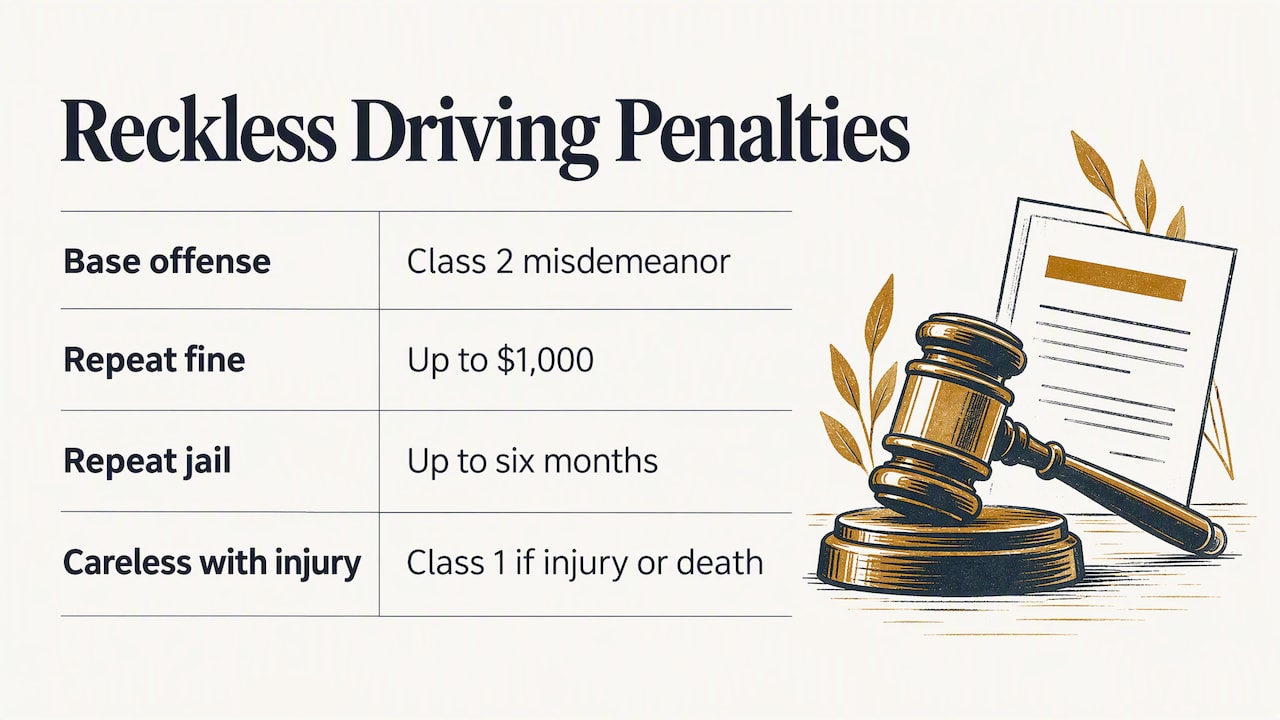
The statute classifies reckless driving as a class 2 misdemeanor. That puts both fines and jail within the court’s reach, and the exact range depends on the statutory text and on the facts of your case. If you want the full numbers, read the statute itself rather than a secondary summary.
A second or later conviction raises the stakes. The statute provides enhanced penalties for repeat offenders, with fines up to $1,000 and jail up to six months. That is why a first offense deserves a serious response. Even a case that feels minor today can follow you into a harsher sentencing range if you are charged again.
In practice, judges handling traffic misdemeanors weigh your driving history, the circumstances of the stop, and whether anyone was hurt. Injury or serious property damage can change how the case is charged and negotiated. Prosecutors sometimes add or substitute other counts when a collision causes harm, which is why the details of the crash matter so much.
Many people also confuse this charge with careless driving, a lesser offense that becomes a class 1 misdemeanor when it causes bodily injury or death.
How do DMV points and administrative actions affect your license?
A reckless driving conviction adds 8 points to your driving record. Adults who reach 12 points within 12 months can face a license suspension, so one conviction puts you most of the way to the line. Add a speeding ticket or another moving violation within the same year, and you could cross it.
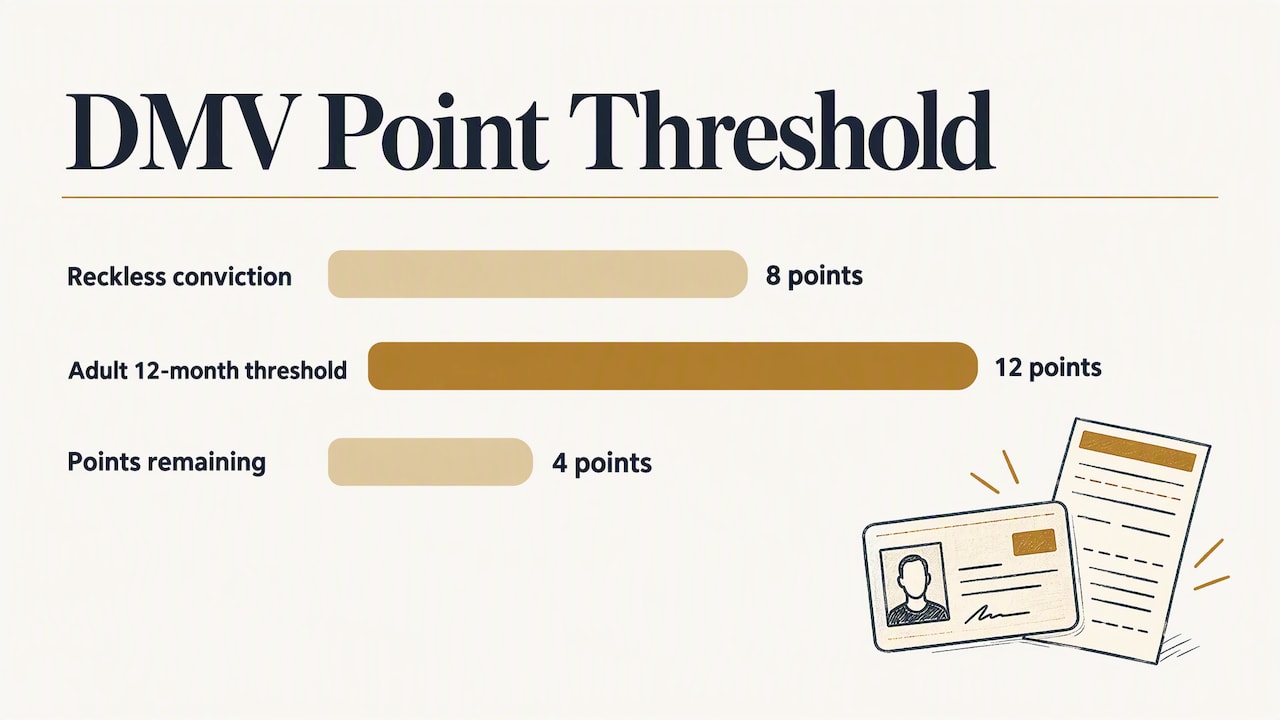
The DMV is a separate system from the criminal court. Its administrative hearings work like civil proceedings with a lower burden of proof, and they review license restraints and point calculations. You can win or settle in criminal court and still face a licensing consequence. The reverse is also true.
That split is why timing matters. Waiting until after a plea to think about your license can lock in consequences that were avoidable. We explain how the thresholds work in our guide to driver’s license points in Colorado, and our breakdown of Colorado traffic fines and point values shows how other violations stack with this one.
What happens after you receive a reckless driving citation?
Reckless driving is a class 2 offense, and that shapes the process. Colorado’s rules for county court traffic violations bureaus let clerks process many infractions but exclude class 1 and class 2 offenses and cases involving accidents. Those matters go before a judge, so you cannot simply mail in a payment and move on.
At your first appearance, the court typically advises you of your rights. The Judicial Branch’s advisement form tells defendants they can have a lawyer, can stay silent, and can demand a hearing where the allegations must be proven beyond a reasonable doubt. It also warns that waiving those rights may mean fines and points. The court’s ticket FAQ adds that you may get a chance to meet with the district attorney, and that court staff cannot give legal advice.
Track every date on your paperwork. Missed deadlines create new problems. Our article on when a traffic ticket becomes a criminal charge covers that line in more detail.
What conduct and evidence lead to reckless driving charges?
Charges usually follow driving that looks deliberate or extreme rather than merely careless. Common patterns include:
- Extreme speeding well beyond a normal ticket
- Aggressive weaving, tailgating, or road-rage behavior
- Eluding or fleeing an officer
- Street racing
- Maneuvers that cause a crash, injury, or property damage
Prosecutors build the case from whatever proof is available. That often includes the officer’s observations, accident reports, dashcam or bodycam footage, witness statements, vehicle data recorders, and speed measurements such as radar or lidar readings.
Their argument is straightforward. They point to the speed, the traffic around you, the road conditions, and the choices you made, then ask the court to infer that you knew the risk and drove anyway. Your job, with counsel, is to test each piece. Was the radar calibrated? Does the video match the officer’s account? Do the witnesses agree? Evidence that looks overwhelming in a police report often looks thinner once someone examines it closely.
How can you defend against or reduce a reckless driving charge?
Every case turns on its own facts, but several defense theories come up often:
- No wanton or willful mental state. A lapse in attention or an honest misjudgment does not meet the statutory standard.
- Mistaken identity. Someone else was driving, or the officer followed the wrong vehicle.
- Measurement errors. Speed readings can be unreliable if equipment was not used or maintained properly.
- An unlawful stop. If the stop lacked a legal basis, evidence may be challenged.
- Necessity. You drove as you did to avoid a greater, immediate harm.
- Witness credibility. Inconsistent or biased accounts weaken the state’s story.
Many cases resolve through negotiation. A common goal is a reduction to careless driving or a lesser infraction, which can mean fewer points and a lighter record. That is a reasonable target when the evidence is mixed or your history is clean. Push toward motions or trial when the proof of intent is thin, the video helps you, or an officer’s testimony has problems.
Pro Tip: Save your dashcam footage, photos of the road, and witness contact details right away, since evidence disappears quickly and early preservation gives your attorney more to work with.
What should you do right after being cited?
Small early mistakes can cost you leverage. Start here:
- Don’t plead or pay the ticket without advice, and read every rights advisement before you waive anything.
- Photograph the scene, the road signs, and any vehicle damage while you can.
- Collect names and phone numbers for witnesses.
- Request the police report as soon as it is available.
- Put every court date on your calendar and note any DMV deadlines.
- Talk to a traffic or criminal defense attorney promptly, before you speak with the DA.
What a former prosecutor sees that most drivers miss
Having sat on the other side of the table, I can tell you that a reckless driving file often looks stronger on paper than it is. A prosecutor weighs evidence quickly, and knowing which gaps matter shapes what concessions are realistic. A smaller caseload also means I can personally review video, challenge measurements, and prepare for trial instead of defaulting to the fastest plea. When you meet any lawyer, ask who will handle your case, what the likely reductions are, and what evidence they would want first.
— Joshua
How we help with a reckless driving charge in Colorado
We handle traffic and misdemeanor defense personally, and attorney Josh McDowell works every case himself. Early on, we review the evidence, speak with the DA, and represent you in court, all aimed at protecting your record and your license. We can’t promise a specific outcome, but we will tell you plainly where your case stands. 
Ready to talk it through? Schedule a consultation through our traffic defense page and bring your citation with you.
This article is general information, not a substitute for advice from a qualified lawyer. Consult a qualified legal professional about your own circumstances before acting on anything here.
FAQ
How much is a reckless driving ticket in Colorado?
Reckless driving is a class 2 misdemeanor, so the amount comes from the statute and the judge, not a fixed ticket price. Repeat convictions carry enhanced penalties, according to the statute. A lawyer can tell you what range fits your case.
Is 6 points on your license bad in Colorado?
Six points alone does not trigger suspension for adults, since the threshold is 12 points within 12 months. Still, points add up fast, and a reckless driving conviction brings 8 on its own. A few more points in the same year can put your license at risk.
What is the difference between careless and reckless driving?
Reckless driving requires wanton or willful disregard for safety. Careless driving is a lower standard and a lesser charge, though it becomes a class 1 misdemeanor if it causes bodily injury or death. Reductions from reckless to careless are a common goal in negotiation.
Do I have to go to court for reckless driving?
Usually yes. Court rules exclude class 2 offenses from clerk processing, so these cases go before a judge. Don’t skip your date.
Sources
- Colorado Revised Statutes Section 42-4-1401 (2025) – Reckless driving – penalty :: 2025 Colorado Revised Statutes :: U.S. Codes and Statutes :: U.S. Law :: Justia
- Suspension and Reinstatement FAQs | Department of Revenue – Motor Vehicle
Recommended
- Colorado Traffic Fines: Violations & The Points if Convicted
- Careless Driving vs Reckless Driving: What’s the Difference?
Made with BabyLoveGrowth to rank on Google and in AI search
The post Colorado Reckless Driving: 8 Points and a Former Prosecutor’s Advice first appeared on McDowell Law Firm.
from McDowell Law Firm https://mcdowellfirm.com/reckless-driving-colorado/
https://mcdowellfirm.com/practice-area/dui-defense/

No comments:
Post a Comment