If you’re facing criminal charges in Colorado, you probably have questions about jail time, probation, fines, and whether you’ll end up with a criminal record. But there’s another part of sentencing that can have a significant financial impact: restitution.
Restitution is money a court orders you to pay for financial losses caused by a crime. Depending on the allegations, that amount could be a few hundred dollars or tens of thousands.
Here’s something you should understand before accepting a plea bargain: Just because a prosecutor requests a particular amount of restitution doesn’t mean you’re legally obligated to pay it.
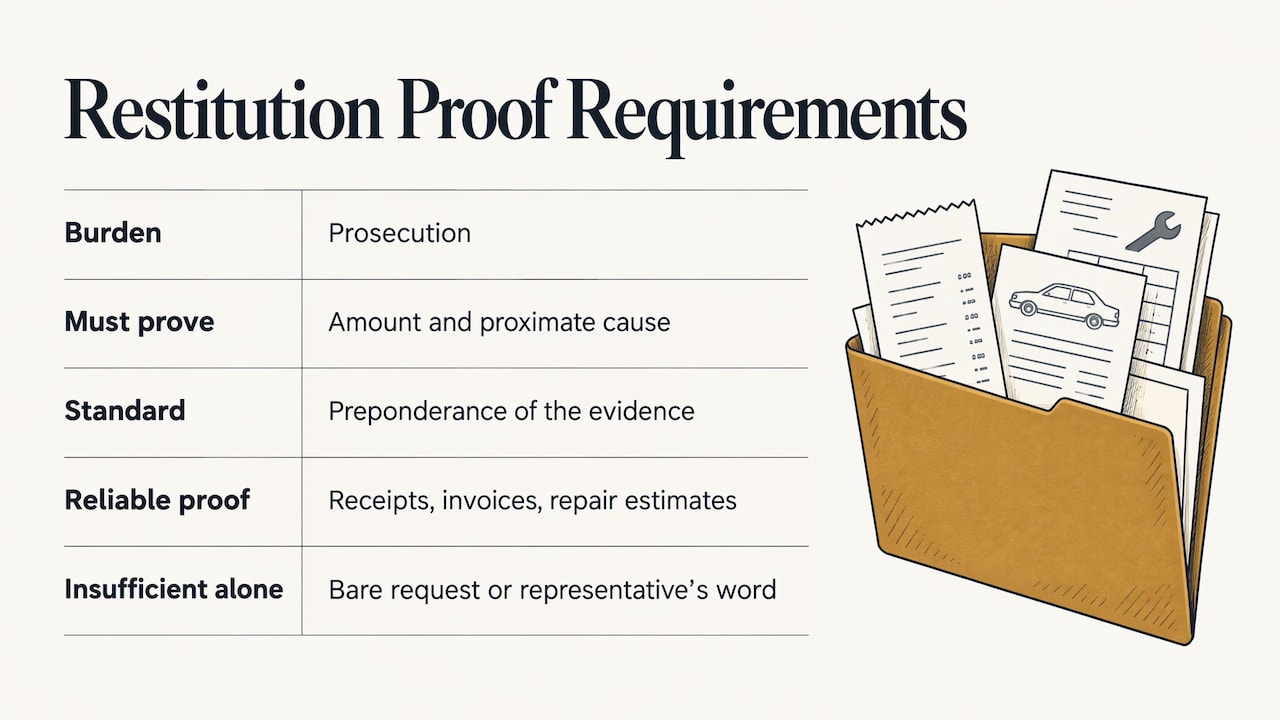
The prosecution has to establish that the claimed losses are legally recoverable, that your criminal conduct caused them, and that the requested amount is supported by the evidence.
I’ve practiced criminal law in Colorado Springs since 2004, first as a Deputy District Attorney and now as a criminal defense attorney. I’ve seen restitution become a major issue in cases where the defendant was initially focused almost entirely on avoiding jail.
Understanding the potential restitution before you plead guilty can save you from a financial obligation that follows you for years.
What Is Restitution in a Colorado Criminal Case?
Restitution is a court-ordered payment intended to compensate a victim for certain financial losses resulting from criminal conduct.
Colorado’s restitution laws are primarily found in C.R.S. §§ 18-1.3-601 through 18-1.3-603.
Unlike a criminal fine, which is imposed as punishment, restitution is intended to reimburse victims for actual economic losses.
For example, if someone is convicted of criminal mischief or theft, restitution might include the value of stolen property or the cost of repairing damaged property.
In an assault case, it might include medical expenses.
In a DUI case involving an accident, restitution may include certain financial losses associated with the collision, although insurance coverage and the nature of the conviction can significantly affect what is recoverable.
Restitution is part of criminal sentencing. It isn’t a separate civil lawsuit, although victims and insurers may have separate civil remedies.
Colorado’s definition of conviction for restitution purposes also includes deferred judgments and deferred adjudications, subject to the statutory provisions governing successful completion.
What Types of Losses Can Be Included in Restitution?
Under C.R.S. § 18-1.3-602, restitution generally includes financial losses proximately caused by criminal conduct that can reasonably be calculated and compensated with money.
Depending on the case, those losses may include:
-
Medical bills and treatment expenses.
-
Repair costs for damaged property.
-
The value of stolen or destroyed property.
-
Certain lost wages resulting from an injury.
-
Towing and other accident-related expenses.
-
Reasonably established future treatment expenses.
-
Certain investigative expenses.
-
Interest or loss of use of money.
-
Other measurable economic losses directly attributable to the offense.
The key issue is causation.
The prosecution must prove that the claimed loss was proximately caused by the criminal conduct for which restitution is legally authorized.
That becomes important when a victim claims losses that existed before the incident, are unrelated to the offense, or are based on assumptions rather than supporting evidence.
What Restitution Does Not Cover
Colorado law expressly excludes several categories of damages from criminal restitution.
These include:
-
Physical pain and suffering.
-
Mental pain and suffering.
-
Loss of enjoyment of life.
-
Loss of consortium.
-
Loss of future earnings.
-
Punitive damages.
Those categories may be relevant in a civil lawsuit, but they are generally not recoverable through Colorado’s criminal restitution process.
One distinction deserves attention.
Lost wages and lost future earnings are not necessarily the same thing.
For example, a victim who misses six weeks of work following an assault may be entitled to restitution for proven lost wages. But a claim for earnings the victim expects to lose years into the future falls within the statutory exclusion for loss of future earnings.
That distinction can make a significant difference in the amount requested.
Colorado Changed the Rules for Insurance Companies in 2026
One of the most significant recent changes to Colorado restitution law concerns insurance companies.
House Bill 26-1017 was signed into law on April 2, 2026, and took effect on August 12, 2026.
Before this change, insurance companies could often seek criminal restitution for payments they made to their policyholders.
The new law substantially limits that practice.
Under HB 26-1017, restitution generally excludes losses for which a victim may be compensated through private insurance, except for workers’ compensation insurance.
You can review the legislation here: Colorado HB 26-1017.
How Does a Colorado Court Determine Restitution?
Colorado law requires nearly every qualifying criminal conviction to address restitution.
Under C.R.S. § 18-1.3-603, the sentencing court generally must enter one or more of four types of restitution orders.
-
An order requiring payment of a specific restitution amount.
-
An order establishing an obligation to pay restitution, with the specific amount determined later.
-
An order requiring payment for the actual costs of certain future treatment.
-
A finding that no victim suffered a qualifying financial loss and no restitution is owed.
The second option is common.
A defendant may be sentenced while the final amount of restitution remains unresolved.
That doesn’t mean the prosecution has unlimited time to submit a request.
Colorado law establishes deadlines for both the prosecutor and the court.
What Are the Deadlines for Restitution in Colorado?
Colorado changed its restitution deadlines in 2025.
House Bill 25-1304, effective May 30, 2025, established a new process for defendants sentenced on or after that date.
Under the revised law:
The prosecutor generally has 63 days after the order of conviction to submit restitution information if the information was not available beforehand.
The court may extend that deadline when it finds extenuating circumstances affecting the prosecutor’s ability to determine restitution.
The court generally must determine the specific restitution amount within 63 days after the prosecution submits its information, or within 63 days after the order of conviction, whichever is later.
The court may extend its deadline for good cause.
For defendants sentenced before May 30, 2025, the former 91-day provisions generally govern.
These deadlines are important because the prosecution cannot simply ignore the statutory process and request restitution whenever it chooses.
But an untimely request doesn’t automatically mean the defendant owes nothing.
The specific court orders, extensions, objections, and actions of the parties all matter.
What Happens If the Restitution Deadline Is Missed?
Two Colorado Supreme Court decisions from 2025 are particularly important.
In Snow v. People, 2025 CO 32, the sentencing court improperly deferred the issue of restitution in its entirety and later entered an untimely restitution order.
The Colorado Supreme Court held that the sentence was unauthorized because the court failed to enter one of the restitution orders required by statute.
The Court ordered the subsequent restitution order vacated and directed the trial court to enter an order reflecting that no restitution was owed.
But there is another side to the issue.
In People v. Roberson, 2025 CO 30, the Supreme Court held that a defendant can waive the statutory deadline.
In that case, the defendant did not object when the court scheduled proceedings beyond the deadline, requested multiple continuances, and waited until long after the deadline had passed before raising the issue.
The Supreme Court concluded that her conduct constituted a waiver.
These decisions illustrate why restitution deadlines should be evaluated carefully.
If the prosecution misses a deadline, I want to know why. Was an extension requested? Did the court make the necessary findings? Did defense counsel object? Did the defendant agree to additional time?
Those questions may determine whether a restitution order can be challenged.
Do You Have the Right to Attend?
Yes.
In People v. Martinez Rubier, 2024 COA 67, the Colorado Court of Appeals confirmed that defendants have a due process right to be present at restitution hearings.
A defendant can waive that right, but the waiver must be knowing, intelligent, and voluntary.
Defense counsel cannot simply waive the defendant’s right to attend without the defendant’s authorization.
In Martinez Rubier, the Court of Appeals reversed a restitution order because the trial court conducted a hearing without adequately establishing that the defendant had waived his right to be present.
If you have a restitution hearing scheduled, you should discuss attendance with your attorney and make sure your rights are protected.
How I Evaluate a Restitution Request
When the prosecution submits a restitution request, I look closely at several issues.
Causation. Did the defendant’s conduct actually cause the claimed loss?
Documentation. Does the prosecution have records supporting the amount, or is it relying on estimates or unsupported assertions?
Preexisting losses. Is the victim seeking compensation for damage or expenses that existed before the incident?
Reasonableness. Are the claimed expenses related to the offense and supported by the evidence?
Insurance. Does the 2026 insurance legislation limit or prohibit the requested restitution?
Scope of conviction. Does the request involve acquitted, uncharged, or dismissed conduct outside the scope of a valid restitution agreement?
Deadlines. Did the prosecution and court comply with the statutory deadlines?
Duplicate recovery. Has the victim already received compensation that should be considered under the governing law?
These issues can make a significant difference.
A restitution request should be examined rather than accepted simply because a prosecutor submitted it.
Can a Restitution Order Be Changed Later?
Sometimes.
Colorado law permits certain corrections or modifications of restitution orders, but it does not give the prosecution an unrestricted right to increase restitution after the statutory process is complete.
The statute allows certain adjustments involving newly discovered victims or losses, payments already made, and other specifically authorized circumstances.
The timing and procedural posture of the case matter.
If restitution has already been ordered and you believe the amount is incorrect, your attorney should evaluate whether a statutory correction, appeal, or other appropriate legal remedy remains available.
Do not assume that the court can reopen restitution indefinitely.
How Much Interest Is Charged on Colorado Restitution?
Colorado generally imposes simple interest on unpaid restitution at an annual rate of 8%.
Under C.R.S. § 18-1.3-603(4), interest ordinarily begins accruing when the restitution order is entered.
The Colorado Judicial Branch calculates interest monthly based on the outstanding principal balance.
For example, consider a $10,000 restitution order.
At 8% simple annual interest, that produces $800 in interest over a year if the principal remains unchanged.
That’s approximately $66.67 per month.
The larger the unpaid principal balance, the more interest accumulates.
There are statutory exceptions.
For families dealing with juvenile charges, my juvenile criminal defense page explains other important differences between juvenile and adult criminal proceedings.
What If You Cannot Afford to Pay Restitution?
Many defendants cannot pay the full restitution amount immediately.
That does not automatically eliminate the obligation.
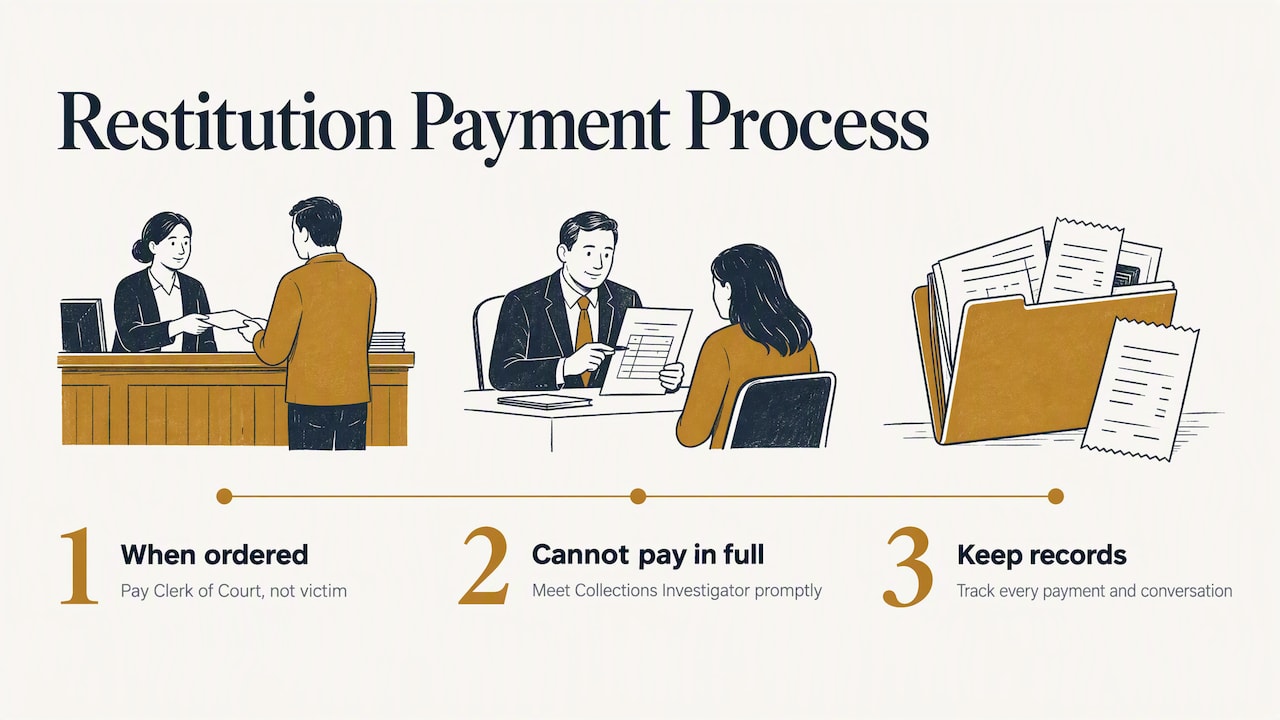
Colorado courts have collection procedures that allow qualifying defendants to establish payment arrangements based on their circumstances.
A Collections Investigator may review your income, expenses, employment, and financial resources.
If you cannot pay the full amount, take the collection process seriously.
Provide accurate financial information, keep records of your payments, and communicate promptly if your circumstances change.
The court may also impose authorized collection fees and other costs.
Can You Go to Jail for Not Paying Restitution?
You cannot constitutionally be incarcerated solely because you genuinely lack the financial ability to pay.
However, an intentional refusal to comply with lawful payment obligations can create additional problems.
If restitution is a condition of probation, nonpayment may lead to allegations of a probation violation.
The distinction between someone who cannot pay and someone who willfully refuses to pay is legally significant.
If a probation revocation is based on failure to pay restitution, the court must consider the applicable constitutional protections and circumstances surrounding nonpayment.
For more information, read Probation Violations in Colorado.
If you are struggling with payments, do not ignore the court or your probation officer.
Get legal advice before a missed payment develops into a larger problem.
What Happens If You Do Not Pay Restitution?
Unpaid restitution can remain enforceable for years.
Depending on the circumstances, Colorado’s collection process may include:
-
Wage garnishment.
-
Liens against property.
-
Interception of state tax refunds or other qualifying payments.
-
Referral to collection agencies.
-
Additional collection expenses.
-
Other enforcement proceedings authorized by law.
Restitution does not necessarily disappear when probation ends.
It also generally survives criminal record sealing.
A restitution balance may affect eligibility for sealing in some cases, depending on the applicable statute.
The practical point is simple.
If the court orders restitution, you need to understand the amount, how it will be collected, and what options you have if payment becomes difficult.
Does Restitution Affect Plea Bargaining?
Absolutely.
Restitution should be part of the conversation before you accept any plea agreement.
Consider a defendant who receives an offer allowing probation instead of jail.
On its face, that may sound like a favorable resolution.
But suppose the agreement also requires $30,000 in restitution.
Now the defendant must evaluate the financial consequences along with the criminal penalties.
I also want to know whether the restitution amount is fixed in the plea agreement or will be determined later.
If the amount is left open, a defendant may plead guilty without knowing the full financial obligation.
Sometimes the parties can negotiate a specific amount or otherwise narrow the issues. In other cases, restitution must be litigated.
The facts, the charges, the statutory requirements, and the available evidence determine what is possible.
This is especially important in theft and property crime cases, where the alleged financial loss may be one of the central issues in the prosecution.
The best time to address restitution is before a plea is entered, not after sentencing.
How to Challenge a Restitution Request in Colorado
If you’re facing a restitution claim, there are several things you should do.
1. Find out what the prosecution is requesting.
Ask your attorney for the amount claimed and the documentation supporting it.
2. Review the evidence.
Invoices, repair estimates, medical records, employment records, and photographs may all be important.
3. Identify unrelated expenses.
Look for preexisting property damage, medical conditions, duplicate charges, or expenses unrelated to the offense.
4. Review the plea agreement.
Determine whether you agreed to pay restitution for dismissed charges or other conduct.
5. Check the deadlines.
The prosecution and court must follow the applicable statutory procedures. A timely objection may be critical.
6. Request a hearing when appropriate.
If the prosecution cannot substantiate the claimed losses or there is a legitimate legal dispute, a restitution hearing may be necessary.
7. Understand the consequences before accepting an amount.
A restitution order can create a substantial financial obligation, including interest and collection costs.
Do not agree to a restitution figure simply because it appears in a prosecutor’s paperwork.
Colorado Springs Criminal Defense Attorney for Restitution Disputes
I’ve represented people charged with crimes in Colorado Springs and El Paso County since 2007.
Before becoming a defense attorney, I worked as a Deputy District Attorney in the Fourth Judicial District, where I handled restitution issues for victims.
That experience gives me an understanding of how criminal cases are prosecuted, how plea agreements are negotiated, and how restitution requests are assembled.
When I represent a client, I review the evidence and evaluate the legal and financial consequences of the proposed resolution.
If restitution is disputed, I want to know whether the amount is supported, whether the requested losses are legally recoverable, and whether the prosecution has complied with Colorado law.
My goal is to protect my client’s rights and pursue the best result available under the circumstances.
If you’ve been charged with a crime in Colorado Springs or El Paso County, or you need representation concerning a disputed restitution order, contact McDowell Law Firm.
Call 719-227-0022 to schedule a free consultation.
You can also read what to expect during a free consultation.
Frequently Asked Questions About Colorado Restitution
Is restitution mandatory in every Colorado criminal case?
Most qualifying criminal convictions must address restitution, but that does not mean every defendant must pay it. If no victim suffered a legally recoverable financial loss, the court may enter an order finding that no restitution is owed. The statute also contains limited exceptions to its general requirements.
Can restitution be ordered after sentencing?
Yes, if the sentencing court enters an appropriate restitution order and the prosecution and court comply with the applicable statutory procedures and deadlines.
How long does the prosecution have to request restitution?
For defendants sentenced on or after May 30, 2025, the prosecution generally must submit the information before the order of conviction or within 63 days afterward if the information was unavailable, subject to statutory extensions. The court has a separate 63-day deadline calculated under C.R.S. § 18-1.3-603.
Can you challenge the amount of restitution?
Yes. The prosecution must establish the required causal connection and the amount of legally recoverable loss. You may dispute the evidence and request an appropriate hearing.
Can you be ordered to pay restitution for dismissed charges?
Potentially. A defendant may expressly agree to restitution involving dismissed charges as part of a valid plea agreement. The specific language matters.
Does insurance eliminate restitution?
Not in every case. Colorado’s 2026 legislation generally excludes losses compensable through private insurance, but exceptions exist for workers’ compensation, certain deductibles, and insurers that qualify as direct victims. The applicable law and effective date must be considered.
Does restitution accrue interest?
Generally, yes. Colorado imposes simple interest at 8% annually on unpaid restitution, subject to statutory exceptions.
Does restitution go away when probation ends?
Generally, no. Unpaid restitution can remain enforceable even after probation terminates.
Can restitution prevent your criminal record from being sealed?
Potentially. Depending on the case and applicable sealing statute, unpaid restitution may affect eligibility or the timing of sealing.
Can I go to jail if I genuinely cannot afford restitution?
The Constitution prohibits incarceration solely because of genuine inability to pay. However, willful failure to comply with lawful payment obligations can have serious consequences, including revocation proceedings.
Should I hire a lawyer to challenge restitution?
If the amount is substantial, the documentation is questionable, the claimed losses are disputed, or the prosecution may have missed a deadline, having an attorney review the request can be important.
A restitution order may affect your finances long after the criminal case ends.
Colorado Restitution Laws and Cases
This article provides general information about Colorado law as of November 2026. It is not legal advice for your individual circumstances. Reading this article does not create an attorney-client relationship.
The post Restitution in Colorado Criminal Cases: What You May Owe and How to Fight It first appeared on McDowell Law Firm.
from McDowell Law Firm https://mcdowellfirm.com/restitution-colorado-criminal/
https://mcdowellfirm.com/practice-area/dui-defense/

No comments:
Post a Comment