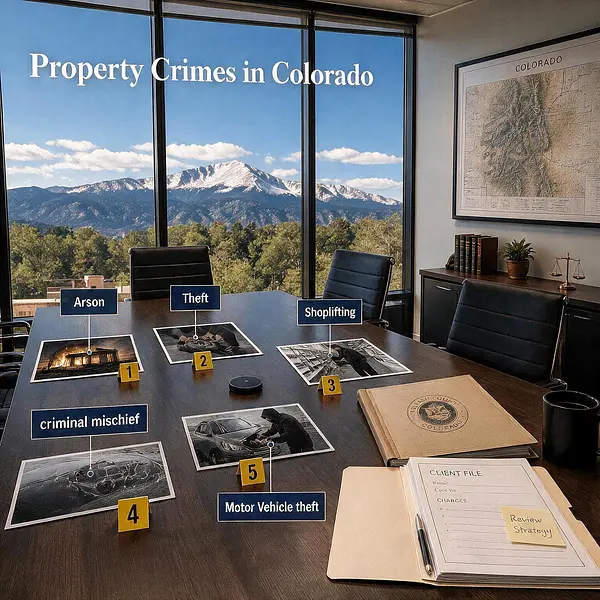
Property crimes are offenses where the property is the subject of the offense. Some good examples of property crimes include theft, arson, burglary, and shoplifting. The level of these crimes can vary greatly based on the value, damage, and nature of the crime.
Colorado property crimes range from petty offenses, such as theft or property damage involving less than $300, to class 2 felonies. A low-dollar allegation can still carry jail time and a criminal record, while the most serious property offenses can expose a person to decades in prison.
Don’t take property crime allegations lightly. Even in cases where no one was physically injured, the property may have been returned, or the amount involved may seem small. You may assume you can explain the situation to the police, pay for the damage, and move on.
That is often where people make their first mistake.
Colorado property crime cases can carry jail or prison, fines, restitution, probation, and a criminal record. Some charges depend on the value of property. Others depend on what the prosecution claims you intended to do. A burglary case, for example, may turn less on what was taken than on why the government says you entered or remained in a building.
In Colorado, prosecutors treat arson cases incredibly seriously. With a history of devastating fires in El Paso County, it’s understandable why.
The benefits of hiring a property crime defense lawyer in Colorado begin well before trial. A defense lawyer can protect you during an investigation, stop you from giving the government evidence it does not already have, examine how police obtained their evidence, and begin building a defense before important records or witnesses disappear.
If the police ask your side of the story, remember this: they are usually trying to build a case, not clear up a misunderstanding. You have the right to remain silent. Use it. Then call a lawyer.
What Is Considered a Property Crime in Colorado?
Colorado places many property crimes in Article 4 of the Criminal Code. Other related offenses, including identity theft, appear elsewhere. The label “property crime” covers a wide range of conduct, from a low-level shoplifting allegation to a serious felony burglary or arson case.
Common property crime charges include:
Theft
Colorado’s theft statute, C.R.S. § 18-4-401, covers more than physically taking an item. A person may be accused of theft for obtaining, retaining, or exercising control over another person’s property without authorization, or through threat or deception, when the required intent or knowledge is present.
The value of the property can change the level of the charge. Theft may range from a petty offense to a serious felony. The type of property and the alleged victim can also affect how a case is charged.
A lawyer for theft charges can help you understand the specific allegations, potential penalties, and defenses available in your case.
Shoplifting
Shoplifting is generally prosecuted under Colorado’s theft law. These cases are often filed in City (municipal) Court if they happened within city limits. These cases may involve allegations that a person concealed merchandise, changed a price tag, failed to scan an item, passed a point of sale without paying, or helped another person take merchandise.
Store security video is often the most important piece of evidence in a shoplifting offense. However, these cases aren’t always open and shut. Your lawyer should review the full video, the payment record, witness statements, and the circumstances surrounding the alleged loss.
Burglary
Burglary does not require proof that anything was stolen. Colorado burglary charges usually focus on whether a person unlawfully entered or remained in a building or occupied structure with the intent to commit a crime inside.
First, second, and third-degree burglary carry different elements and penalties under C.R.S. §§ 18-4-202 through 18-4-204.
A dispute about permission to enter, ownership, identity, or intent can be central to the defense.
Criminal Mischief
Criminal mischief under C.R.S. § 18-4-501 involves knowingly damaging another person’s real or personal property. It can also apply to property owned jointly with someone else. This matters in domestic and family disputes, where a person may mistakenly believe that co-ownership prevents a criminal charge.
You can break your own stuff, but putting a hole in the wall of a rented apartment or the marital home can get you charged with criminal mischief.
The amount of alleged damage affects the offense level. Repair estimates, replacement claims, depreciation, and the actual condition of the property factor into the level of the charges.
Criminal Trespass
Colorado has first, second, and third-degree criminal trespass under C.R.S. §§ 18-4-502 through 18-4-504. The degree can depend on the type of property involved and the conduct alleged. Trespass cases often involve questions about notice, permission, property boundaries, locked vehicles, dwellings, and whether the accused knew the entry or remaining was unlawful.
Arson
Colorado recognizes several degrees of arson under C.R.S. §§ 18-4-102 through 18-4-105. Depending on the charge, the prosecution may need to prove knowing, intentional, or reckless conduct involving fire or explosives. The ownership and occupancy of the property, the danger created, and the amount of damage may affect the charge.
Motor Vehicle Theft
Motor vehicle theft is covered by C.R.S. § 18-4-409. These cases can involve allegations of taking, keeping, exercising control over, or receiving a vehicle without authorization. The facts may raise issues involving consent, mistaken ownership, borrowed vehicles, rental agreements, identification, and what the accused knew about the vehicle.
I have seen cases where a child was charged with AMVT for taking a parent’s car without permission (usually after an accident). I have also seen cases where a person is charged with keeping a vehicle after the rental agreement period expired.
These are many defenses and elements to consider in motor vehicle theft cases that add nuance and/or mitigation to the offense.
Identity Theft
Identity theft under C.R.S. § 18-5-902 generally involves using another person’s personal identifying or financial information without permission for an unlawful purpose.
These cases often depend on digital records, account access, device evidence, financial transactions, and proof of who actually used the information. These charges most often arise from using a credit card (or other financial means/device) of another without permission.
Receiving Stolen Property
People still use the phrase “receiving stolen property,” but Colorado repealed its former standalone theft-by-receiving statute. Conduct involving knowingly receiving, retaining, or controlling stolen property is generally prosecuted under the current theft statute, C.R.S. § 18-4-401.
Possession alone does not answer every question. The prosecution must still prove the elements of the charged offense, including the required mental state. How the property was acquired, what the accused was told, what the property looked like, and what the accused said to police may all matter.
A common charge that we see with theft crimes is also false information to a pawn broker. See C.R.S. 12-56-104(5), and C.R.S. 29-11.9-104(5) to learn about the levels of charges for providing false info when pawning an item. Maybe I’m dating myself a little, but when I was a DA, we’d often see people who would bring CDs (yes, music used to be on discs, kids…) to pawn brokers that they had obtained through illegal means.
Stolen CDS would typically bring $1-$3 per CD so it was an easy thing to shoplift and walk right over to the pawn shop for easy cash. And subsequently, several criminal charges.
Why Property Crime Charges Should Never Be Taken Lightly
Property crime charges vary widely. A first shoplifting allegation is not the same as first-degree burglary. Still, even a case that begins as a misdemeanor can cause lasting damage.
Depending on the charge and facts, the possible consequences may include:
- Jail or prison
- Court-ordered fines and costs
- Restitution for proven losses
- Supervised or unsupervised probation
- Community service or treatment requirements
- A criminal record that appears in background checks
- Difficulty finding or keeping employment
- Housing and rental problems
- Professional licensing consequences
- Immigration consequences for noncitizens
- Firearm restrictions after certain convictions
Restitution deserves special attention. The amount requested by an alleged victim or insurer is not always the correct legal amount.
A lawyer can examine whether the claimed loss was directly caused by the criminal conduct, whether insurance or returned property affects the calculation, and whether repair or replacement figures are supported.
A conviction can also reach beyond the sentence imposed in court. Employers, landlords, licensing boards, schools, and immigration authorities may evaluate the same case under different rules. That is why a proposed plea should be judged by its full effect, not only by whether it avoids jail.
10 Benefits of Hiring a Property Crime Defense Lawyer in Colorado
1. Protects Your Constitutional Rights
Police may ask for consent to search your home, car, phone, computer, backpack, or other property. They may also ask you to explain where an item came from or why you were at a particular location.
You do not need to help police build a case against you. A lawyer can communicate with investigators, advise you whether to provide any information, and challenge evidence obtained in violation of the Fourth, Fifth, or Sixth Amendments.
One of the main reasons to hire a property crime defense lawyer in Colorado is to make sure the government follows the rules while investigating you.
2. Evaluates Whether Police Made Mistakes
Property crime investigations often rely on searches, warrants, witness identifications, surveillance video, location data, phone records, and statements. Each step creates opportunities for error.
A lawyer can examine questions such as:
- Did police have probable cause for the search warrant?
- Did the warrant describe the correct place and items?
- Did officers exceed the scope of the warrant?
- Was consent to search actually voluntary?
- Was the detention unlawfully extended?
- Were statements obtained after an improper custodial interrogation?
- Was evidence preserved and handled correctly?
If evidence was obtained illegally, the defense may ask the court to suppress it. Suppression can weaken the prosecution’s case and, in some cases, lead to dismissal.
3. Reviews Every Piece of Evidence
The police report is a starting point. It is not the whole case.
A property crime attorney can seek body-camera footage, dispatch records, store video, photographs, receipts, repair estimates, forensic reports, device-extraction records, social media evidence, and witness statements. The defense can also look for material the initial investigator ignored.
Video should be viewed in full when possible. A short clip may leave out what happened before or after the alleged offense. A written summary of a recording may omit facts that help the defense.
4. Identifies Weaknesses in the Prosecution’s Case
The prosecution must prove every element beyond a reasonable doubt. A defense lawyer looks for the gap between suspicion and proof.
Common weaknesses include:
- Lack of criminal intent
- Mistaken identity
- Permission or a reasonable belief that permission existed
- Joint ownership or a legitimate claim of right
- Unreliable eyewitness testimony
- Incomplete or unclear video
- Unsupported property values or damage estimates
- Lack of proof that the accused knew property was stolen
- Weak digital attribution
- Evidence obtained through an unlawful search or interrogation
A person can be near stolen property without stealing it. A person can possess another’s property without knowing it was stolen. A person can enter a place without intending to commit a crime inside. Those distinctions can decide a case.
5. Develops the Strongest Defense Strategy
There is no single defense to every property crime. The right strategy depends on the statute, the evidence, the accused person’s history, and the goal of the case.
Possible defenses may include lack of intent, consent, mistaken identity, alibi, a legitimate claim of right, insufficient proof of value, lack of knowledge, duress, entrapment, or constitutional violations. Some cases require immediate preservation of surveillance footage or electronic records. Others require an investigator, forensic specialist, appraiser, or expert witness.
The importance of hiring a property crime lawyer in Colorado is especially clear when early decisions could limit later defenses.
6. Negotiates to Reduce or Dismiss Charges
Many criminal cases resolve without trial, but effective negotiation requires more than asking the prosecutor for leniency. The defense must show why the government’s proof is weak, why a legal issue creates risk, or why a fair resolution serves the interests of justice.
Depending on the case, an attorney may seek dismissal, a reduction from a felony to a misdemeanor, a deferred judgment, a non-jail sentence, a restitution agreement, or another outcome that limits long-term harm. No lawyer can promise a particular result. A strong factual and legal presentation can improve the position from which negotiations begin.
7. Helps You Avoid Maximum Penalties
If a conviction cannot be avoided, the defense still matters at sentencing. A lawyer can present mitigation, correct inaccurate information, contest an unsupported restitution request, and propose a sentence that addresses the court’s concerns without imposing unnecessary punishment.
Mitigation may include employment history, education, treatment, mental health evidence, community support, voluntary restitution, lack of prior convictions, and the circumstances surrounding the offense. Timing matters. An attempt to pay restitution or contact an alleged victim without legal advice can sometimes create new evidence or violate a protection order.
8. Protects Your Future Beyond the Courtroom
The best result is not always the plea with the shortest sentence. A conviction can affect employment, housing, education, security clearances, professional licenses, immigration status, and firearm possession.
An attorney should consider whether a proposed disposition may later qualify for record sealing and whether the language of the plea creates added risk. Noncitizens should also obtain advice from a qualified immigration attorney before accepting a plea. Immigration law can treat theft and fraud offenses differently from Colorado criminal law.
This is one of the strongest advantages of hiring a Colorado property crime attorney. The lawyer can evaluate the entire cost of an outcome before you agree to it.
9. Represents You Confidently in Court
Court involves deadlines, evidentiary rules, motions, witness examinations, and strategic choices. A property crime lawyer can appear with you, explain what will happen, argue motions, cross-examine witnesses, negotiate with the prosecutor, and try the case when necessary.
Trial preparation also affects negotiation. Prosecutors know which defense lawyers are willing and able to take a case to a jury. A defense prepared for trial has more credibility when it points out problems in the government’s evidence.
10. Provides Peace of Mind During a Stressful Time
Criminal charges create uncertainty. You may worry about work, family, money, and what will happen in court. You may also receive advice from friends or online sources that does not fit your case.
A lawyer gives you one reliable place to get answers. You should know what you are charged with, what the prosecution must prove, what evidence exists, what defenses may apply, and what comes next. No attorney can remove all uncertainty, but informed decisions are easier than guesses.
Why Hiring a Former Prosecutor Can Be an Advantage in Property Crime Defense
Before I became a criminal defense lawyer, I served as a Deputy District Attorney in Colorado’s Fourth Judicial District. That experience matters because prosecutors and defense lawyers examine the same file from different positions.
A former prosecutor may bring practical insight into:
- How charging decisions are made
- Which facts a prosecutor is likely to emphasize
- What evidence may change a prosecutor’s evaluation
- How plea offers are assessed
- When a case is likely to proceed to trial
- How local judges and court procedures affect strategy
Former prosecutorial experience is not a guarantee of a result. It is a useful perspective. I know how the government builds a property crime case because I have worked on both sides of a criminal courtroom.
Local experience also matters. Procedures and negotiation practices can differ between judicial districts, counties, and municipal courts. A lawyer who regularly appears in Colorado Springs and El Paso County can prepare you for the court where your case will actually be heard.
When Should You Contact a Property Crime Defense Lawyer?
Contact a lawyer as soon as you learn that you may be under investigation. Do not wait for formal charges if police are already gathering evidence.
You should seek legal advice if you have been:
- Arrested for a property crime
- Contacted by a detective or other law enforcement officer
- Asked to give a written, recorded, or in-person statement
- Told that police want to search your phone, home, car, or computer
- Served with a summons or complaint
- Accused of theft, burglary, shoplifting, criminal mischief, trespass, arson, motor vehicle theft, or identity theft
- Identified as a suspect by an employer, store, neighbor, former partner, or family member
- Accused in juvenile court of conduct involving theft or property damage
If police say they only want to hear your side, you should still speak with a lawyer first. An innocent explanation can be misunderstood, contradicted by incomplete evidence, or used to fill a hole in the investigation.
Do not delete messages, destroy records, contact witnesses to influence what they say, or return property without legal advice. Preserve relevant information and let your attorney decide how it should be handled.
How Much Does It Cost to Hire a Property Crime Defense Lawyer?
There is no single fee for every property crime case. The cost depends on factors such as:
- Whether the charge is a petty offense, misdemeanor, or felony
- The number and seriousness of the charges
- Whether the case is still under investigation
- The volume of video, financial, or digital evidence
- Whether expert witnesses or investigators are needed
- Whether motions must be litigated
- Whether the case resolves through negotiation or goes to trial
Some criminal defense lawyers charge a flat fee for defined stages of a case. Others charge hourly. Ask what the quoted fee covers, whether trial is included, whether expert or investigation costs are separate, and whether payment arrangements are available.
Is it worth hiring a property crime attorney in Colorado? When your freedom, record, career, or immigration status may be affected, the cost of handling the case poorly can be far greater than the legal fee. The best way to learn what representation will cost is to speak privately with a lawyer who knows the exact charge and facts.
Why Choose The McDowell Law Firm for Property Crime Defense?
I began my legal career as a Deputy District Attorney in El Paso County. I have practiced criminal defense since 2007. That experience allows me to evaluate a case from both sides while giving every client a defense built around the actual facts.
At The McDowell Law Firm, you receive:
- Representation from former prosecutor Joshua J. McDowell
- Extensive Colorado criminal defense experience
- A strategy tailored to your evidence, priorities, and risk
- Local courtroom experience in Colorado Springs and El Paso County
- Direct, client-focused communication
- Careful negotiation backed by trial preparation
- A free and confidential initial consultation
Why choosing a Colorado property crime lawyer matters is simple. Colorado statutes, local procedures, and the facts of your case control what happens next. You need advice based on those facts, not a generic answer from the internet.
If you are facing a property crime investigation or charge in Colorado Springs, call The McDowell Law Firm at 719-227-0022. The earlier we become involved, the more opportunity we may have to protect evidence, control communication with police, and shape the defense.
Frequently Asked Questions
1. Do I need a lawyer for a property crime charge in Colorado?
You are not legally required to hire a lawyer, but handling a criminal charge alone can expose you to avoidable risks. Even a lower-level offense may result in jail, probation, restitution, and a criminal record.
A lawyer can explain the charge, review the evidence, identify defenses, negotiate with the prosecutor, and represent you in court. If you are asking, “Should I hire a property crime lawyer in Colorado?” get a consultation before making statements or accepting an offer.
2. What crimes are considered property crimes in Colorado?
Common examples include theft, shoplifting, burglary, criminal mischief, criminal trespass, robbery, arson, motor vehicle theft, and conduct involving stolen property.
Identity theft is generally classified as a fraud offense under Article 5, but it is often discussed with property crimes because it involves unauthorized use of another person’s identifying or financial information.
3. Can a property crime charge be dismissed in Colorado?
Yes, a charge may be dismissed, but dismissal depends on the facts and law. Reasons may include insufficient evidence, witness problems, mistaken identity, lack of intent, proof of permission or ownership, suppressed evidence, or a negotiated case resolution. A lawyer cannot guarantee dismissal.
4. How does the value of stolen or damaged property affect criminal charges?
For theft and criminal mischief, value or damage can determine whether an offense is charged as a petty offense, misdemeanor, or felony. Under Colorado’s current value scale, the levels generally rise at $300, $1,000, $2,000, $5,000, $20,000, $100,000, and $1 million.
Special rules may apply based on the property, victim, offense, aggregation of multiple acts, or other circumstances. The defense can challenge how the government calculated value or damage.
5. What if I was falsely accused of a property crime?
Do not try to fix the accusation by repeatedly contacting the alleged victim or explaining yourself to police. Preserve messages, receipts, location records, video, photographs, and witness information.
A lawyer can present exculpatory evidence in a controlled way while protecting you from creating harmful statements.
6. Can a first-time offender avoid jail for a property crime in Colorado?
Sometimes. The outcome depends on the offense, loss amount, evidence, criminal history, victim’s position, restitution, and local sentencing practices.
Possible resolutions may include dismissal, a deferred judgment, probation, community service, or another non-jail sentence. Serious burglary, robbery, arson, and high-value theft cases may carry substantial incarceration exposure even for a person with no prior record.
7. What should I do if police want to question me about a property crime?
The same thing I always say: Don’t answer any questions. About the case. Be polite. Say that you want to remain silent and speak with a lawyer.
Do not consent to searches. Do not lie, argue, resist, or physically interfere with officers. Ask whether you are free to leave. If you are allowed to leave, do so calmly and contact an attorney.
8. Can a lawyer negotiate reduced charges for a property crime?
Yes. That’s one of the most important parts of a defense attorney’s job. Depending on the evidence and circumstances, a lawyer may negotiate for dismissal, reduced charges, a deferred judgment, a sentencing agreement, or reduced restitution. The strength of the defense often determines the quality of the negotiation.
Your criminal defense attorney will examine the evidence to determine the strengths/weaknesses of a case, determine if there are potential suppression issues or defenses, and provide counsel every step of the way.
9. Will a property crime conviction affect my future?
It can. A conviction may affect employment, housing, professional licensing, education, security clearances, immigration status, and firearm rights. Whether a record can later be sealed depends on the charge, disposition, waiting period, and criminal history.
These issues should be considered before entering any plea. Many charges can be sealed in Colorado after the required waiting period. Speak to your attorney about your situation to see if and when your case will be eligible.
10. Can illegally obtained evidence be used against me?
Evidence obtained through an unconstitutional search or interrogation may be suppressed after a successful motion hearing. Suppression is not automatic, and the DA will often fight suppression motions bitterly. Some cases live and die based on evidence that was obtained through potentially unconstitutional means.
The prosecutor knows how important that evidence may be in a case, and in many instances, without that evidence, the case cannot proceed. This shows the importance of certain pieces of evidence. Cases where a stop is illegal, and evidence is obtained as a result of the illegal stop, can also be suppressed.
You may have heard the phrase “fruit of the poisonous tree”; this refers to the exclusionary rule, making evidence inadmissible if it was obtained by unconstitutional/illegal means.
11. How can a local Colorado property crime defense lawyer help my case?
A Colorado Springs lawyer brings knowledge of Colorado law, local court procedures, prosecutors, judges, and available programs. The lawyer can also respond quickly to court dates and investigate evidence in the area. Local knowledge does not guarantee an outcome, but it can help the defense make informed decisions.
I’ve been handling criminal cases in El Paso County since 2004. First as a DA, and then as a defense attorney since 2007. Personally, I prefer that the majority of my work is in the Fourth Judicial District (El Paso and Teller Counties) and Colorado Springs, because I’ve been in one or more of those Courthouses almost every single weekday for the last 22 years.
12. What defenses are available for property crime charges?
Potential defenses include lack of intent, consent, mistake of fact, mistaken identity, alibi, claim of right, lack of knowledge, insufficient proof of value, unreliable witnesses, incomplete video, weak digital attribution, duress, entrapment, and violations of constitutional rights.
The available defense depends on the elements of the specific charge and the evidence. Defenses are fact-specific to a case, and not one-size-fits-all. Before we decide the best defense in your matter, we need to understand the charges, the evidence, and the facts of your case.
When someone asks me on the phone what I expect in their case, I tell them how the process works. Attorneys can’t give well-informed advice on how your case will resolve until they see the discovery and understand the facts/evidence in your case. “Am I going to prison?” “Will I be convicted?” The truth is, no attorney can (responsibly) answer that on your first phone call.
The reason you hire a professional is to review your case, and then they work to obtain the most favorable outcome for you. This is like asking a doctor over the phone about a serious illness before exams, imaging, blood work, etc. “How bad is it, Doc? How long do I have?” If that doctor tells you, maybe you should keep looking for another doctor.
Talk to a Colorado Springs Property Crime Defense Lawyer
If you are under investigation or have been charged, do not wait for the case to get worse before asking for help. Call The McDowell Law Firm at 719-227-0022 to request a free, confidential consultation. Our office is located at 2 N. Cascade Avenue, Suite 1220, in downtown Colorado Springs. We serve El Paso and Teller Counties and the greater Colorado Springs area.
Every case is different. This article provides general information and is not legal advice. Do not rely on a blog post to make decisions about a pending criminal case.
Speak with a qualified attorney about your specific facts. As with all my blog posts, they serve as informational reads to familiarize yourself with some of the basics of a topic in Colorado law. A criminal case is complex and has a lot of moving parts and variables.
The post Benefits of Hiring a Property Crime Defense Lawyer in Colorado first appeared on McDowell Law Firm.
from McDowell Law Firm https://mcdowellfirm.com/benefits-of-hiring-a-property-crime-defense-lawyer-in-colorado/
https://mcdowellfirm.com/practice-area/dui-defense/


No comments:
Post a Comment