You’ve been pulled over for speeding, and the officer tells you he is going to search your car.
Can he do that?
Police take your phone and tell you they are keeping it.
Is that legal?
You refuse a blood test after a DUI arrest. The officer tells you he will get a warrant and take your blood anyway.
Can he really do that? What if I refuse?
I have handled criminal and DUI cases in Colorado Springs for more than 20 years, first as a Deputy District Attorney and since 2007 as a criminal defense attorney. I hear some version of this question all the time:
“Can the police actually do that?”
Usually, the answer is “it depends.”
Not every answer is cut-and-dried. It depends on what the police are trying to do and what information they have at the time. These answers aren’t always easy. That’s why fact patterns are argued in court for a judge to decide. Even when a Judge decides, many search and seizure cases still go up on appeal for another Judge to review the facts and the legal application. Appellate courts stay busy with just this sort of issue because, even for lawyers and Judges, these aren’t always easy answers.
There are three terms we need to discuss when considering law enforcement searches: reasonable suspicion, probable cause, and a warrants.
They are all important parts of a legal search and seizure, but they are not the same thing.
The Fourth Amendment protects you from unreasonable searches and seizures. Article II, Section 7 of the Colorado Constitution provides similar protection. But neither constitution says police always need a warrant.
Sometimes police need reasonable suspicion.
Sometimes they need probable cause.
Sometimes probable cause is enough to act without a warrant.
Other times, police may have probable cause and still need to go to a judge.
So what can the police actually do in Colorado?
Key Takeaways
- Police generally need probable cause or legal authority to search or arrest someone in Colorado.
- A search warrant must be supported by probable cause and identify the person, place, or property to be searched.
- Police can make some arrests without an arrest warrant when Colorado law provides legal grounds for the arrest.
- Warrantless searches are limited by constitutional protections, although specific exceptions may allow a search without a warrant.
- An unlawful search or arrest can affect the admissibility of evidence, making it important to understand your rights and available legal remedies.
Reasonable Suspicion vs. Probable Cause: What Is the Difference?
Let’s start with the terminology.
Reasonable suspicion is the lower standard of the two.
An officer needs specific facts that reasonably suggest criminal activity may be occurring. It has to be more than a hunch.
The landmark case is Terry v. Ohio, 392 U.S. 1 (1968). Terry allows police to briefly detain someone to investigate suspected criminal activity when the officer has reasonable, articulable suspicion.
Probable cause is a higher standard.
Probable cause generally exists when the facts would lead a reasonably cautious person to believe that a crime occurred, that a particular person committed it, or that evidence of a crime will be found in a particular place.
It does not mean the police have enough evidence to convict you.
This standard is well below “beyond a reasonable doubt”
In Illinois v. Gates, 462 U.S. 213 (1983), the Supreme Court explained that probable cause is based on the totality of the circumstances. Courts look at the entire picture rather than applying a mathematical formula.
Then there is a warrant.
A warrant is not really another level of suspicion. Usually, it means the police took their probable cause to a judge, explained what they wanted to do, and received judicial authorization for a search/seizure.
That distinction matters because sometimes probable cause lets police act immediately. Sometimes it only gives them enough evidence to ask a judge for a warrant.
Want to learn more? explore our complete guide on ‘Probable Cause vs Reasonable Suspicion in Colorado‘
Can the Police Detain Me Without Probable Cause?
You bet. They do it all the time.
Police do not need probable cause to briefly detain you. Reasonable suspicion can be enough. You may have seen cases online or on TV where the police say, “You’re not under arrest, but I am detaining you right now.” There’s a reason they do that, but there is an important step before that.
Police do not need any suspicion at all to walk up and talk to you if the encounter is truly voluntary. An officer can approach you on the sidewalk, ask your name, ask where you are going, or ask if you will answer some questions.
The constitutional issue changes when you are no longer free to leave.
That is a detention.
Under Terry, police need reasonable suspicion to detain you for investigation.
Colorado follows the same rule. People v. Ball, 2017 CO 108, discusses the limits on investigative detentions. Police can investigate based on reasonable suspicion, but the detention must remain reasonably related to a legitimate investigative purpose.
Let me give you an example.
Police receive a description of someone who just burglarized a house. A few blocks away, they see someone reasonably matching that description. White male, with a black hoodie and jeans.
They may be able to stop that person, ask questions, check identification, and investigate.
They do not need probable cause to make that initial stop.
But suppose five minutes later it becomes obvious they have the wrong person. Police cannot keep the person there for another hour just to see if something else turns up.
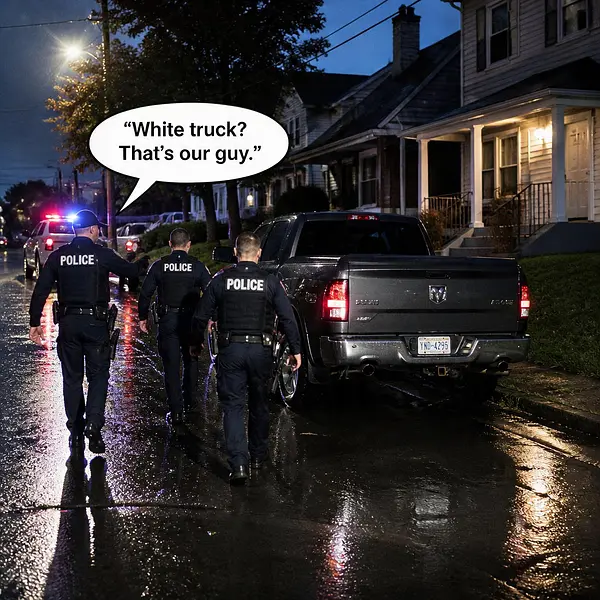
Real Case: I had a case where police were investigating a burglary. They were looking for a “White truck”, that was the entire description. 2 miles away and 30 minutes later, my client was stopped by police based on “reasonable suspicion”. He was in a dark grey truck. (Note: He was also drunk.)
At was then the police stopped worrying about him as a burglary suspect, and started processing him for DUI.
During the subsequent DUI case, I challenged the stop. My position: this is Colorado; you can’t walk a block without seeing three trucks. And dark grey isn’t close to white.
They didn’t describe the driver, the make or model of the truck. Driving a truck 2 miles from the burglary does not equal reasonable suspicion.
Verdict: As we were sitting in the courtroom getting ready to call the officer to the stand, the DA said, “You’re right, it isn’t even close. I’ll dump it.”
A detention is supposed to investigate the reasonable suspicion that justified it.
There is another misconception I see often.
Being lawfully detained does not automatically mean police can frisk you.
A Terry frisk requires an additional safety justification. The officer must have a reasonable basis to believe the person may be armed and dangerous.
A Terry frisk is a limited search for weapons. It is not supposed to be a general evidence search.
Can the Police Arrest Me Without a Warrant?
Yes.
In Colorado, police generally can arrest you without an arrest warrant when they have probable cause (we often say “PC”) to believe an offense occurred and probable cause to believe you committed it. Colorado also addresses warrantless arrest authority in C.R.S. § 16-3-102.
A good example are domestic violence cases. If law enforcement has PC for a DV in Colorado, you’re spending the night in jail.
The U.S. Supreme Court recognized the general constitutional rule for public arrests in United States v. Watson, 423 U.S. 411 (1976).
A very recent Colorado case shows why the “you committed it” part matters.
In People v. McGee, 2026 CO 14, police were investigating sexual offenses involving a suspect who was supposed to meet someone at a park. Officers knew the suspect was believed to be a man in his thirties who used a scooter.
McGee showed up at the park on a scooter around the expected time.
Police arrested him.
The problem was identification.
The Colorado Supreme Court held that the description used by police was not specific enough to establish probable cause that McGee was the actual suspect. The court suppressed the evidence that resulted from the unlawful arrest.
That is a good example of probable cause in the real world.
Police can have strong evidence that somebody committed a crime. That does not automatically give them probable cause to arrest you.
They need enough information connecting you to the crime.
The rule also changes when police want to enter your house.
In Payton v. New York, 445 U.S. 573 (1980), the Supreme Court held that police generally cannot make a warrantless, nonconsensual entry into someone’s home to make a routine arrest.
So imagine police have probable cause to arrest you.
If you are standing on the sidewalk, they may be able to arrest you immediately.
If you are sitting inside your house, probable cause alone generally does not give them permission to kick in the door. But if they are chasing a person into the home, the court may look at that differently.
Police ordinarily need an arrest warrant or another legal basis to enter, such as consent or exigent circumstances.
Can the Police Search My Car Without a Warrant in Colorado?
Yes.
This surprises a lot of people.
Cars do not receive the same Fourth Amendment protection as homes.
Under what lawyers call the automobile exception, police can search a vehicle without first getting a warrant when they have probable cause to believe the vehicle contains contraband or evidence of a crime.
The rule dates back to Carroll v. United States, 267 U.S. 132 (1925).
Colorado reaffirmed the automobile exception recently in People v. Furness, 2025 CO 16.
In Furness, officers were investigating gunshots. A witness eventually identified Furness as the shooter. Police searched the vehicle, including the trunk, and found a handgun, ammunition, and drugs.
The Colorado Supreme Court held that the totality of the circumstances gave police probable cause to believe evidence would be found in the trunk.
Note: Totality of the circumstances is a phrase you’ll hear a lot in warrantless search and seizure cases.
Once the automobile exception applies, police do not also need to prove there was no time to get a warrant.
But the search still has limits.
United States v. Ross, 456 U.S. 798 (1982), tells us that police can search areas and containers where the object they are looking for could reasonably be located.
Suppose police have probable cause to believe there is a stolen rifle in your car.
They might be able to search the trunk.
They cannot justify opening a tiny pill bottle by saying they were looking for the rifle.
It obviously cannot be there.
If we change the scenario to be a search for suspected evidence from a rifle to a small bag of cocaine, then suddenly many more places in the vehicle could reasonably contain what police are looking for.
What they have probable cause to look for helps determine where they can look.
There are other exceptions too.
You can consent to a search.
Police can sometimes conduct an inventory search after a lawful impoundment.
Police may also conduct a limited protective search for weapons when they reasonably believe an occupant is dangerous and could gain access to a weapon.
Michigan v. Long, 463 U.S. 1032 (1983), established that rule.
Colorado applied it in People v. Delacruz, 2016 CO 76. Among other facts, the officer saw a large knife near the passenger’s feet. The Colorado Supreme Court upheld a limited protective search behind the seats for additional weapons as a lawful search.
But this is important: reasonable suspicion that someone may be dangerous is not the same thing as probable cause to search the entire car for evidence.
A weapons search is supposed to be about safety.
Arresting the driver also does not automatically give police the right to search the car.
Arizona v. Gant, 556 U.S. 332 (2009), limited that rule. Police may search the passenger compartment incident to arrest when the arrested person could access it at the time of the search, or when it is reasonable to believe the car contains evidence of the offense of arrest.
If you are arrested for driving on a suspended license, the arrest by itself does not give police unlimited authority to start digging through your car looking for drugs.
You can
Can the Police Impound My Car in Colorado?
Yes, but the impound itself needs to be lawful.
This is one of my favorite Fourth Amendment issues because police departments sometimes treat “our policy allows it” as the end of the analysis.
It is not.
Police perform what courts call a community caretaking function.
Sometimes a car legitimately has to be removed.
Maybe it is blocking traffic.
Maybe it was involved in a crash.
Maybe it is sitting somewhere unsafe.
Maybe the driver was arrested and there is no reasonable way to leave the car where it is.
None of that requires probable cause that drugs or evidence are inside the car. The purpose of the impound is supposed to be caretaking, not criminal investigation.
People v. Brown, 2018 CO 27, 415 P.3d 815, is a great Colorado example.
Brown was stopped for driving with a suspended license. Officers decided not to arrest him. They gave him a summons.
They still impounded his BMW.
During the inventory search, they found crack cocaine.
The Colorado Supreme Court held the impoundment unconstitutional. There was no evidence the BMW was blocking traffic, creating a safety problem, or could not be safely removed by someone else.
“Because the record fails to demonstrate that seizure of the defendant’s vehicle was justified as an exercise of the police caretaking function or was otherwise reasonable within the meaning of the Fourth Amendment, regardless of local ordinances or police policies and procedures broad enough to grant the officers discretion to impound the vehicle of a driver merely summoned rather than arrested for driving with a suspended license, the judgment of the court of appeals is affirmed.”
The fact that department policy allowed officers to impound the car did not make the seizure reasonable under the Fourth Amendment.
That creates two separate questions in an impound case.
First, could police lawfully impound the car?
Second, did they conduct a lawful inventory search after impounding it?
Those are different questions.
South Dakota v. Opperman, 428 U.S. 364 (1976), and Colorado v. Bertine, 479 U.S. 367 (1987), recognize legitimate inventory searches.
But inventory searches are supposed to follow standardized procedures. They exist to document property, protect property, protect police from claims of missing property, and address safety concerns.
People v. Allen, 2019 CO 88, is important here. The Colorado Supreme Court suppressed evidence found during an alleged inventory search because the prosecution did not establish that officers decided to impound and inventory the car under standardized criteria or policies.
Calling something an “inventory search” does not automatically make it one.
Can the Police Take My Phone?
Sometimes.
But taking the physical phone and searching what is inside the phone are two different Fourth Amendment questions.
If police lawfully arrest you and your phone is in your pocket, they can generally take the phone from you and secure it.
That does not mean they can start reading your texts.
Riley v. California, 573 U.S. 373 (2014), is the landmark case.
The Supreme Court recognized the obvious reality that a smartphone is different from a wallet, cigarette pack, or other physical item carried in a pocket.
Your phone may contain years of photographs, messages, emails, financial records, location history, internet searches, medical information, and communications with dozens or hundreds of people.
Police ordinarily need a warrant to search that digital information.
Colorado has also dealt with the seizure of the phone itself.
In People v. Ramos, 2022 CO 16, police received an anonymous tip involving alleged child pornography. They located a phone associated with Ramos and seized it without a warrant.
The prosecution failed to establish probable cause and a valid exception justifying the warrantless seizure. The evidence was suppressed.
So if police take your phone, I want to know two things.
Why were they legally allowed to take it?
And what gave them authority to get inside it?
Can the Police Search My Phone With a Warrant?
Usually, yes.
But “we have a warrant” does not mean police can automatically search every piece of information stored on the device.
A warrant has to be sufficiently particular.
Coke v. People, 2020 CO 28, is an important Colorado cell phone case.
Police obtained a warrant that broadly authorized them to search texts, photos, videos, contacts, phone records, and other data on the phone.
The Colorado Supreme Court found the warrant overbroad. It did not sufficiently limit the search based on the alleged offense, victim, or relevant time period.
That matters.
A search warrant is not supposed to be permission to look through your entire digital life hoping something incriminating turns up.
Police need probable cause, and the warrant needs to describe what they are authorized to search for with sufficient particularity.
Can the Police Make Me Unlock My Phone?
This one gets complicated.
There is a difference between police having legal authority to search the phone and police having legal authority to force you to help them unlock it.
In People v. Davis, 2019 CO 24, Davis voluntarily gave police his passcode so an officer could access his phone and find his girlfriend’s phone number.
Police later obtained a valid search warrant.
They used the same passcode Davis had already voluntarily disclosed.
The Colorado Supreme Court held that police could use it. Once Davis voluntarily disclosed the digits to law enforcement, he no longer had a reasonable expectation that those digits would remain private from the police.
But that is not the same situation as police ordering you to tell them a password you have never disclosed.
A memorized passcode can raise Fifth Amendment issues because police are potentially forcing you to communicate information that exists in your mind.
Colorado addressed a related, but different, question in People v. d’Estree, 2024 COA 106.
Police used specialized software to conduct a brute-force attack and discover a phone PIN. The Colorado Court of Appeals held that obtaining a private PIN in this way constitutes a Fourth Amendment search and requires warrant authorization.
The court specifically distinguished that issue from the Fifth Amendment question of forcing a defendant personally to reveal a PIN or unlock the phone.
That question was not before the court.
So I would be very careful with any simple statement that “police have a warrant, therefore they can make you tell them your password.”
A warrant to search the phone and an order forcing you to provide information can raise different constitutional issues.
Can the Police Force a Blood Draw in Colorado?
Yes, under some circumstances.
A forced blood draw is a Fourth Amendment search.
The first major Supreme Court case was Schmerber v. California, 384 U.S. 757 (1966). The Court permitted a warrantless blood draw based on the particular circumstances of that case.
But Missouri v. McNeely, 569 U.S. 141 (2013), rejected a blanket rule that alcohol disappearing from the bloodstream automatically creates an emergency allowing a warrantless blood draw in every DUI case.
The circumstances matter.
If police can reasonably obtain a warrant without significantly undermining the investigation, the Fourth Amendment generally requires them to do so.
Colorado applied McNeely in People v. Schaufele, 2014 CO 43.
Police ordered an involuntary hospital blood draw without trying to obtain a warrant. The Colorado Supreme Court affirmed suppression under the circumstances of that case.
Birchfield v. North Dakota, 579 U.S. 438 (2016), also draws an important distinction between breath and blood.
A warrantless breath test may generally be required as a search incident to a lawful DUI arrest.
A blood draw is more intrusive. It does not automatically fall under the same exception.
Colorado also has its Expressed Consent law, C.R.S. § 42-4-1301.1.
Refusing a chemical test can have serious driver’s license consequences. But refusing does not prevent police from applying for a search warrant.
People v. Raider, 2022 CO 40, makes that very clear.
Raider refused testing. Police obtained a blood-draw warrant that authorized reasonable force if necessary. Raider continued to refuse, so he was physically restrained while blood was drawn.
The Colorado Supreme Court held that the restrictions in Colorado’s Expressed Consent statute did not prevent police from executing a valid search warrant.
So if an officer tells you, “You can refuse, but I am going to get a warrant,” he may mean exactly that.
Does a Warrant Mean Police Can Do Whatever They Want?
No.
A warrant has limits.
Generally, police have to establish probable cause to a judge. The warrant also needs to identify with sufficient particularity the place or thing to be searched and what police are looking for.
And the police still have to execute the warrant lawfully.
Two landmark cases explain why all of this matters.
Katz v. United States, 389 U.S. 347 (1967), helped establish modern Fourth Amendment privacy law.
Mapp v. Ohio, 367 U.S. 643 (1961), applied the exclusionary rule to state criminal prosecutions.
That does not mean every police mistake automatically gets every piece of evidence thrown out. Suppression law has its own rules and exceptions.
But it does mean illegal police conduct can become one of the most important issues in a criminal case.
This may be the most important thing to remember. Just because the police violated your rights, it doesn’t mean the case goes away. It usually means that the illegally obtained evidence will be suppressed. That can often mean the case goes away as a result of that suppression, if no other evidence remains for the DA to proceed on the case.
If the stop was illegal, evidence resulting from the stop may be challenged.
If the arrest lacked probable cause, the evidence flowing from the arrest may be challenged.
If the car was unlawfully impounded, the inventory search may be challenged.
If police searched a phone outside the limits of a warrant, that evidence may be challenged.
When I review a criminal case, I do not only ask what the police found.
I want to know how they got there.
Can the Police Do That? The Basic Rules
Here is the easiest way to remember it.
Police can approach you and ask questions without any suspicion if the encounter is voluntary.
Police can briefly detain you when they have reasonable suspicion.
Police generally need probable cause to arrest you without a warrant.
Probable cause can allow police to search a vehicle without a warrant under the automobile exception.
Probable cause alone generally does not allow police to enter your home to make a routine arrest.
Police may be able to seize your phone without immediately having the authority to search the data inside it.
Police ordinarily need a warrant or a recognized warrant exception to search the contents of your phone.
A valid warrant can allow police to obtain your blood even after you refuse a DUI chemical test.
Police can sometimes impound and inventory a vehicle without probable cause, but there must be a legitimate caretaking basis and standardized procedures.
And none of these rules works in a vacuum.
Fourth Amendment cases are extremely fact-specific.
The police report may say “reasonable suspicion,” “probable cause,” “consent,” “exigent circumstances,” “inventory search,” or “protective search.”
Those are legal labels. The court will often review these standards under the totality of the circumstances to determine whether the search was legal or not.
The label the officer writes in the report does not decide whether the police conduct was constitutional.
The facts do.
Were You Illegally Searched or Arrested in Colorado Springs?
If you were arrested or charged with a crime in Colorado Springs and you believe police illegally stopped you, searched your car, impounded your vehicle, seized or searched your phone, entered your home, or forced a blood draw, the search and seizure issues should be reviewed carefully.
A constitutional violation can affect what evidence the prosecution is allowed to use against you, and sometimes it can change the entire case.
The McDowell Law Firm represents people charged with DUI and criminal offenses in Colorado Springs, El Paso County, Teller County, Fort Carson, and surrounding Colorado courts.
Call 719-227-0022 for a free consultation.
This article provides general information about Colorado criminal law and Fourth Amendment search and seizure law. It is not legal advice. Search and seizure cases depend heavily on the individual facts, and different exceptions may apply in a particular case.
The post Can the Police Do That? Colorado Search, Arrest and Warrant Laws first appeared on McDowell Law Firm.
from McDowell Law Firm https://mcdowellfirm.com/colorado-search-arrest-and-warrant-laws-can-the-police-do-that/
https://mcdowellfirm.com/practice-area/dui-defense/

No comments:
Post a Comment