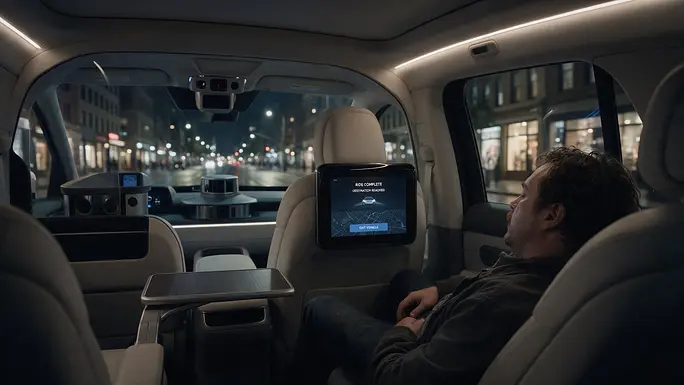
The year is 2031, you’ve had a few too many, and you’re being responsible. You’ll just hop in your flying Tesla and tell it to take you home. Is that considered drunk driving?
How about you call a robotaxi instead? It picks you up, you get in the backseat, and sleep the whole way home. Is that a legal move?
In 2026, we’re not that far off from these scenarios. Tesla’s FSD (supervised) is incredibly sophisticated. Waymo taxis are actively operating in 14 US cities. Tesla robotaxis are rolling out this month.
If your car can steer, brake, and take you home, can you still get a DUI?
These questions would’ve been laughable a decade ago, but at the rate technology is improving, I expect to see issues about actual physical control of a vehicle, man vs. machine, becoming more relevant.
A recent Florida arrest shows why this issue isn’t going away.
“My car was driving itself”
In September 2026, Leesburg police arrested a Cybertruck driver who reportedly insisted he wasn’t driving because his Tesla could drive itself.
According to Leesburg-News, citing the arrest report, a witness said the truck crossed into his lane and forced him off the road. Officers later encountered the driver outside his residence and reported signs of impairment.
He was charged with DUI and refusal to submit to testing.
There have been similar reports elsewhere. In March 2026, the San Francisco Chronicle reported that Vacaville police stopped a moving Tesla whose driver appeared to be asleep. Police alleged impairment from alcohol and marijuana and arrested him on suspicion of DUI.
These are reported arrests, not appellate decisions establishing a new rule. But they illustrate the problem with treating a driver-assistance feature as permission to drink and get behind the wheel.
The word “supervised” matters
Tesla describes Full Self-Driving (Supervised) as driver assistance. It requires active supervision and does not make the vehicle autonomous (yet), but it’s getting pretty darn close. You can verbally give the address to Grok, and you are on the way. It’ll even park for you.
You might ask, “But Josh, what if the car handled every turn and I never touched the wheel?”
That doesn’t resolve the legal question. In Colorado, the prosecution does not necessarily have to prove that you personally steered a moving vehicle. It can establish driving through actual physical control.
The word “control” matters too-You don’t have to be moving to get a Colorado DUI
This surprises people. A parked car can still be the basis of a DUI or DWAI case.
In People v. Swain, 959 P.2d 426 (Colo. 1998), deputies found a pickup parked just off the highway. Swain was lying across the front seat, apparently asleep or passed out. The keys were in the ignition, the radio was playing, and the engine was off.
The Colorado Supreme Court held that actual physical control was sufficient to establish driving under the DUI and DWAI statute. It reinstated his convictions for DWAI and driving without a license.
So “the engine was off” and “I wasn’t moving” do not automatically end the case.
Courts look at the circumstances, including where you were sitting, where the vehicle was located, whether it could be operated, and your access to the controls. The analysis concerns your relationship to the vehicle, not simply whether an officer saw it move.
There are limits to actual physical control
The prosecution still has to prove its case. Being intoxicated somewhere inside a vehicle does not automatically make you its driver.
In People v. VanMatre, 190 P.3d 770 (Colo. App. 2008), the court addressed a vehicle that allegedly had run out of gas and needed a jump-start. The decision explains why operability matters and why the jury must consider the whole situation.
People v. Valdez, 2014 COA 125, further addressed that distinction. Evidence that a vehicle cannot operate, cannot readily be made operable, and is neither moving nor at risk of coasting can negate the driving element.
These are some classic Colorado DUI cases involving conventional vehicles. Applying them to automation requires analysis, not an assumption that every occupant is a driver. The big issue here is actual physical control of the vehicle.
Colorado already allows truly automated driving
Colorado addressed automated vehicles in 2017. C.R.S. § 42-4-242 permits an automated driving system to perform driving functions if it can comply with the state and federal laws applicable to those functions.
The statute also provides that certain laws directed at human drivers do not apply to the automated system itself. That is not a blanket exemption for an impaired human occupant.
CDOT explains that Colorado’s automated-driving category covers SAE Levels 4 and 5. These systems differ from assistance features that require an engaged human driver. Level 4 automation can operate without human supervision within its intended operating conditions. It does not mean the vehicle can drive everywhere in every situation.
This is already relevant in Colorado. Reuters reported on September 1, 2026 that Waymo was beginning to welcome public riders in Denver, with access expanding gradually.
There are still a few kinks that need to be worked out with self-driving. How about a street that is closed off for a specific time period? Like a farmers’ market?
What does that mean for DUI cases?
I looked for any published Colorado appellate decision squarely deciding DUI liability for an occupant while a fully autonomous system does the driving, and couldn’t find any applicable case law. Let’s consider the current DUI law to see how that might apply.
Start with an impaired person supervising a Tesla.
This presents a strong prosecution argument on the driving element. The person occupies the driver’s position, has access to the controls, and is expected to intervene. Activating driver assistance does not erase those facts.
That still doesn’t make every arrest a conviction. The prosecution must prove the charged offense, including the applicable impairment or alcohol-concentration requirements. But “I turned on FSD” is not a sound plan for avoiding DUI liability.
Now consider a privately owned autonomous car with a steering wheel and pedals.
Suppose the vehicle operates in a genuinely driverless mode, but its owner sits behind the wheel and can override the system. These issues are going to be very common in the not-so-distant future.
A prosecutor could argue that the owner retained actual physical control. A defense attorney could argue that the authorized system performed the driving, and the owner had no supervisory role.
The details would matter. Was the autonomous mode actually engaged? Was the car within the conditions that allowed that mode? Did the person have to take over if something went wrong? Could the person access or activate the driving controls? The Swain factors of actual physical control will be contested by both sides.
I wager that the Colorado legislature will enact statutory language that deals with these issues in the near future. I would further wager that the legislature will err on the side of finding the operator is in actual physical control unless very specific criteria are met and may even expand on the Swain factors of actual physical control.
How about a passenger in a driverless taxi?
When you’ve had a few too many, isn’t calling a taxi the right thing to do? Does a person need to consider what type of taxi they call? An impaired person who orders a ride, sits in the passenger area/backseat, and does not operate the vehicle, presents a much stronger argument that there was no driving at all.
In my view, entering a destination and requesting transportation should not, by themselves, make that rider a driver. The absence of a human chauffeur does not automatically transfer control to the passenger. The prosecution has to establish driving or actual physical control.
A future Colorado decision, or legislation, could clarify the details, but current uncertainty is not a reason to equate riding with driving. Especially if the passenger does not or cannot exercise physical control over the vehicle.
The UK offers a useful distinction
The United Kingdom’s Automated Vehicles Act 2024 explanatory notes distinguish between vehicles that require a “user-in-charge” and those that can carry passengers without one.
The law creates protections for certain offenses arising from how an authorized automated vehicle drives. But a user-in-charge still must be qualified and fit to drive, and may have to take control.
That point matters. This is not general permission to get drunk behind the wheel. The UK Highway Code also expressly tells drivers using qualifying self-driving functions that they must remain fit to drive and ready to take over when prompted.
Colorado can learn from that distinction without copying every part of the UK approach.
What Colorado should clarify
I do believe that Colorado lawmakers will address the occupant’s role directly as self-driving vehicles gain popularity.
If a system requires human supervision or a takeover-ready human, the law should clearly state that automation does not excuse impairment.
One potential legislative clarification could be additional language on robotaxis. For example, if a vehicle lawfully completes the trip without a human driver or supervisor, the law should make clear that merely riding, choosing a destination, or requesting a stop does not establish actual physical control.
For vehicles with both manual and autonomous modes, lawmakers could also define when the occupant becomes responsible for driving. That rule should account for the mode actually in use, the occupant’s responsibilities, and access to the controls.
The mere presence of a steering wheel should not be a substitute for that analysis. Clear lines on what determines actual physical control and rider vs. passenger status may be helpful in future statutory language.
I think there is a strong public policy argument to be made that the State should encourage people who have been drinking to arrange safe transportation. Clear rules help them make that choice.
For now, my advice is straightforward: if the vehicle requires you to supervise or take over, don’t use it as your ride home after drinking.
The current status of FSD (Level 2) in Teslas still has the words “supervised” after the FSD. The system is truly incredible, and probably better and safer than the majority of drivers on the road. However, many jurors will likely find that you were in actual physical control of the vehicle while you sat behind the wheel.
Arrange a ride in which you are genuinely a passenger, or get a designated driver.
And if you face a DUI or other traffic allegations involving automated driving, the investigation needs to go beyond what the vehicle is called.
Who controlled it, what the system required, and what the records show could determine the outcome. If you find yourself charged with a DUI in Colorado Springs in a Tesla with FSD, or another self-driving car, give me a call to discuss your defenses.
The post Can You Get a DUI in a Self-Driving Car in Colorado? Know the Law first appeared on McDowell Law Firm.
from McDowell Law Firm https://mcdowellfirm.com/can-you-get-a-dui-in-a-self-driving-car-in-colorado/
https://mcdowellfirm.com/practice-area/dui-defense/

No comments:
Post a Comment