Three traffic convictions can cost you your driver’s license for five years in Colorado. And those convictions do not all have to be for DUI. A combination of reckless driving, driving under restraint, and other qualifying offenses can be enough.
Colorado calls this a habitual traffic offender designation, commonly shortened to HTO.
If the Colorado DMV designates you a habitual traffic offender, your license is generally revoked for five years. If you drive while that revocation remains in effect, you can face a separate criminal charge called Driving After Revocation Prohibited, or DARP.
That charge carries serious penalties, including mandatory sentencing provisions that can involve jail or a substantial fine.
I’m Josh McDowell, a former Colorado Springs prosecutor who has defended criminal and traffic cases since 2007. One thing I regularly explain to clients is that the consequences of a traffic conviction can extend well beyond the sentence imposed by the court.
Before you plead guilty to another traffic offense, you need to understand what that conviction will do to your driving record.
Below, I’ll explain how Colorado’s habitual traffic offender law works, which convictions count, the penalties for driving after revocation, and the defenses that may be available.
What Is a Habitual Traffic Offender in Colorado?
Under C.R.S. § 42-2-202, Colorado can designate someone a habitual traffic offender based on repeated traffic convictions.
There are two ways to qualify:
-
Three or more qualifying convictions arising from separate acts committed within seven years.
-
A specified number of moving violation convictions within five years.
The law applies to both Colorado residents and nonresidents.
Importantly, the statute generally looks at when the offenses occurred, not when the convictions were entered.
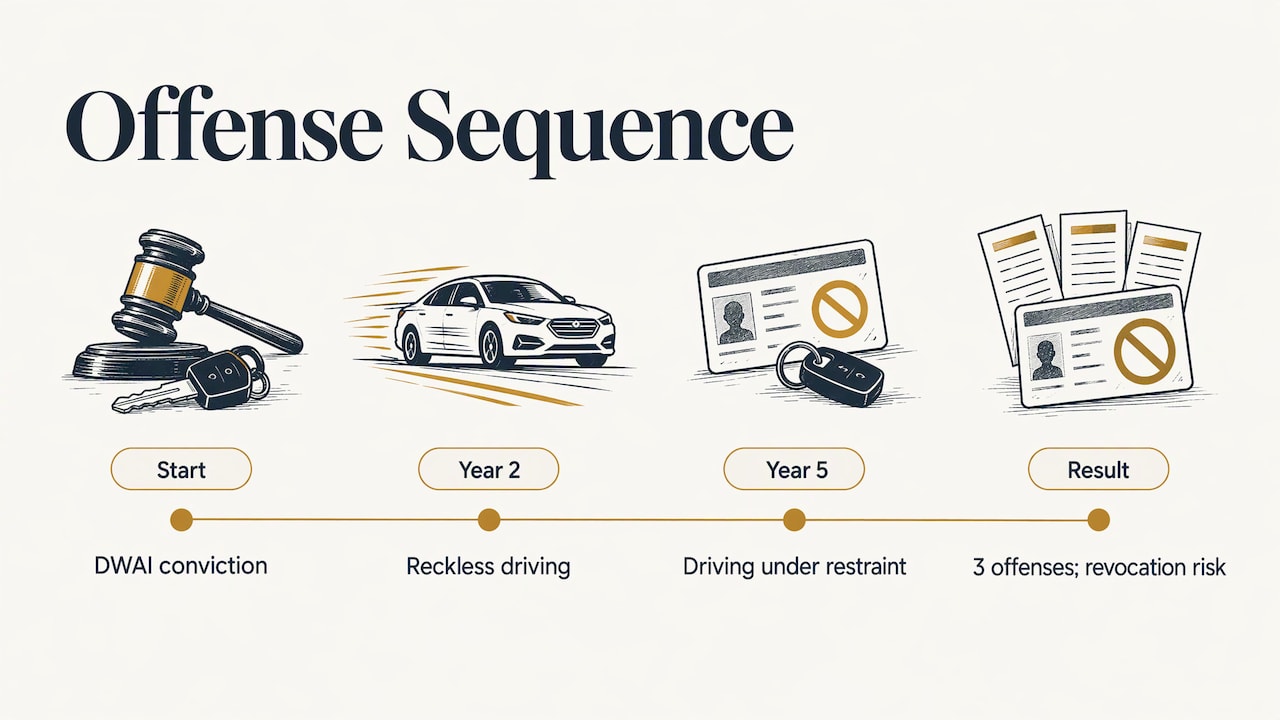
For example, suppose you received a DUI in 2021, a reckless driving charge in 2023, and a driving under restraint charge in 2026.
If you are convicted of all three offenses and they arise from separate acts, you may qualify for habitual traffic offender status.
The fact that none of those offenses involved an injury does not change the result.
Do Multiple Charges From One Traffic Stop Count Separately?
Generally, no.
C.R.S. § 42-2-202 provides that multiple included offenses committed within a one-day period count as one offense for purposes of the habitual traffic offender law.
The statute also requires the qualifying offenses to arise from separate acts.
This distinction matters because a driver might face multiple charges from the same incident. Those charges do not necessarily count as multiple habitual offender violations.
When I review someone’s driving history, I look beyond the number of convictions. I examine the dates, the underlying conduct, and whether the DMV has counted the offenses correctly.
Which Traffic Offenses Count Toward Habitual Offender Status?
Under C.R.S. § 42-2-202(2), three convictions for qualifying offenses committed within seven years can trigger habitual traffic offender status.
The qualifying categories include:
-
Driving under the influence (DUI), DUI per se, or driving while ability impaired (DWAI).
-
Reckless driving under C.R.S. § 42-4-1401.
-
Driving under restraint under C.R.S. § 42-2-138(1).
-
Knowingly making a false affidavit or swearing or affirming falsely regarding information required under Colorado’s motor vehicle laws.
-
Vehicular assault, vehicular homicide, manslaughter or criminally negligent homicide resulting from operating a motor vehicle, or motor vehicle theft, as specified by the statute.
-
Failing to comply with the duties required after a crash involving death or personal injury under C.R.S. § 42-4-1601.
The convictions do not have to be for the same offense.
A DUI, a reckless driving conviction, and a driving under restraint conviction can collectively satisfy the three-conviction requirement.
This is why it is important to look at your entire driving history before resolving a new traffic charge.
Does Reckless Driving Count as a Habitual Traffic Offender Violation?
Yes.
Reckless driving is specifically included in Colorado’s habitual traffic offender statute.
A reckless driving conviction can be particularly significant for someone who already has one or two qualifying offenses.
Keep in mind that Colorado distinguishes between reckless driving and careless driving. They are separate offenses with different elements and consequences.
Reckless driving is expressly listed as a qualifying offense under the three-conviction provision. Ordinary careless driving is not.
I explain the difference in more detail in my article on Careless Driving vs. Reckless Driving in Colorado.
Can Out-of-State Traffic Convictions Count?
Yes. It depends on how they are reported from other states. Typically, you can look at your Motor Vehicle Record (MVR) to see if other out-of-state offenses are showing up on your record.
Colorado’s habitual traffic offender statute allows certain convictions from other states, federal courts, and municipalities to count toward the designation.
Under C.R.S. § 42-2-202(2)(b), the law must substantially conform to the relevant Colorado motor vehicle statutes.
This provision applies to specified categories, including DUI, reckless driving, driving under restraint, and certain serious offenses involving motor vehicles.
Not every out-of-state traffic conviction automatically qualifies.
The actual offense and the law under which the person was convicted matter.
If you moved to Colorado with prior traffic convictions, I would want to review the underlying statutes before accepting the DMV’s calculation.
Can Too Many Traffic Tickets Make You a Habitual Traffic Offender?
Yes. Colorado has a second path to habitual traffic offender status based on repeated moving violations.
Under C.R.S. § 42-2-202(3), you can qualify if you accumulate, within five years:
-
Ten or more convictions for moving violations carrying four or more points each; or
-
Eighteen or more convictions for moving violations carrying three or fewer points each.
The offenses must be separate and distinct, arise from separate acts, and satisfy the statutory reporting and point-assessment requirements.
This is different from the ordinary driver’s license point suspension rules.
You can lose your license through Colorado’s point system without qualifying as a habitual traffic offender.
But a driver with a large number of qualifying traffic convictions may eventually face both issues.
If you are accumulating tickets, pay attention to the points associated with each charge and the effect of another conviction.
My article on when a traffic ticket becomes a criminal charge in Colorado explains the differences between civil traffic infractions and criminal traffic offenses.
How Long Does a Habitual Traffic Offender Revocation Last?
Generally, five years.
Under C.R.S. §§ 42-2-203 and 42-2-205, the Colorado Department of Revenue must revoke the license of a driver whose record meets the habitual offender requirements.
The five-year period begins on the date of the department’s habitual offender order.
During that period, you cannot legally operate a motor vehicle in Colorado unless you qualify for and obtain an authorized early reinstatement.
The DMV’s Hearings Division cannot simply issue you a probationary license because you need to drive for work or family responsibilities.
There are limited statutory provisions allowing certain habitual offenders to reinstate early with an ignition interlock device. I’ll explain those below.
Does Your License Automatically Return After Five Years?
No.
This is something drivers frequently misunderstand.
Even after the five-year period has passed, you must satisfy the applicable reinstatement requirements before you can legally drive.
Those requirements include proof of financial responsibility and may involve other conditions depending on your driving history.
In People v. Purvis, 735 P.2d 492 (Colo. 1987), the Colorado Supreme Court recognized that a habitual offender revocation continues beyond the five-year period until the statutory financial responsibility requirements are satisfied.
Do not assume that the passage of five years means you are legally allowed to drive.
Before getting back behind the wheel, verify that the DMV has actually reinstated your driving privileges.
For more information about checking your driving status and reinstatement requirements, see my Colorado Driver License Guide and Resources.
What Happens If You Drive After a Habitual Offender Revocation?
Driving while your habitual offender revocation remains in effect can result in a criminal charge under C.R.S. § 42-2-206.
The offense is called Driving After Revocation Prohibited, or DARP.
Under Colorado law, the basic offense is a class 2 traffic misdemeanor.
Penalties for Driving After Revocation Prohibited
Under C.R.S. § 42-2-206(1)(a), the sentencing provisions include:
-
A mandatory minimum of 30 days in county jail, or a $3,000 fine, or both.
-
Additional penalties authorized under Colorado’s general traffic sentencing statute.
-
A prohibition against sentencing the defendant to probation.
-
A statutory option allowing the court to suspend all or part of the mandatory jail sentence or fine if the defendant successfully completes between 40 and 300 hours of useful public service.
If the court suspends the mandatory sentence conditioned on public service, successful completion requires the court to vacate the suspended sentence.
If the defendant fails or refuses to complete the ordered service, the court must impose the applicable jail sentence, fine, or both.
There is an important distinction here.
A DARP conviction does not automatically require everyone to serve 30 days in jail. The statute expressly allows a qualifying fine instead of imprisonment.
It also provides the public service alternative described above.
However, this is not an ordinary traffic ticket. The mandatory sentencing provisions and prohibition against probation make the charge significantly more serious.
What Is Aggravated Driving With a Revoked License?
Colorado also recognizes a more serious offense called aggravated driving with a revoked license.
Under C.R.S. § 42-2-206(1)(b), the offense applies when someone who has been designated a habitual traffic offender operates a motor vehicle while the revocation remains in effect and commits one of several specified offenses during the same criminal episode.
Those offenses include:
-
Reckless driving.
-
Eluding or attempting to elude a police officer.
-
Certain violations involving crash duties and reporting requirements.
-
Vehicular eluding.
Aggravated driving with a revoked license is a class 1 traffic misdemeanor.
The statute requires a minimum sentence of 60 days in county jail.
Under Colorado’s general traffic sentencing statute, a class 1 traffic misdemeanor can carry up to one year in jail, subject to the particular offense’s sentencing provisions.
Does a DUI Make Driving After Revocation an Aggravated Offense?
Not under the current aggravated DARP statute.
Colorado removed DUI, DUI per se, and DWAI from the list of aggravating offenses in 2015.
That does not mean driving while revoked and under the influence is treated lightly.
The prosecution may still file a separate DUI or DWAI charge. That offense carries its own penalties and license consequences.
If you are facing an alcohol-related driving allegation, my Colorado Springs DUI defense page explains the criminal and administrative issues that may arise.
Can You Get Your License Back Before the Five Years Are Over?
Possibly.
Colorado law allows certain habitual traffic offenders to apply for early reinstatement with an ignition interlock-restricted license.
But this option is not available to everyone.
Under C.R.S. § 42-2-132.5(4)©, an individual designated as a habitual traffic offender must meet specific criteria to qualify.
The person must have at least one contributing conviction for:
-
DUI;
-
DUI per se; or
-
DWAI.
In addition, the habitual offender designation cannot be based on other contributing violations except for driving under restraint or reckless driving.
For example, someone whose three qualifying convictions consist of a DUI, reckless driving, and driving under restraint may qualify for early reinstatement if the remaining statutory and DMV requirements are satisfied.
However, someone whose qualifying convictions include vehicular assault generally would not qualify through this particular habitual offender early reinstatement provision.
How Long Do You Have to Wait for Early Reinstatement?
There is no single waiting period that applies to every habitual traffic offender.
The applicable rules depend on the underlying offenses, when they occurred, and whether the driver has other active restraints.
Under the DMV’s early reinstatement rules, certain alcohol-related revocations may allow an application on the first day the revocation becomes effective. Others, including certain refusal cases, require a waiting period.
The DMV must determine the driver’s eligibility based on the complete record.
Do not assume that you are eligible after two months simply because you have an alcohol-related conviction.
You can review the state’s Early Reinstatement with Interlock information or contact Colorado DMV Driver Services at 303-205-5613.
How Long Will You Need an Ignition Interlock?
Under C.R.S. § 42-2-132.5, habitual traffic offenders whose revocations were based in part on DUI, DUI per se, or DWAI must generally hold an interlock-restricted license for at least one year after reinstatement before qualifying for an unrestricted license.
Depending on the person’s other alcohol-related convictions, persistent drunk driver designation, and early reinstatement circumstances, the actual interlock period may be longer.
For drivers approved for early reinstatement, the restrictions can extend through the remaining restraint period.
Colorado also has specific rules for interlock monitoring, servicing, violations, and extensions.
For a detailed explanation, read my Colorado Ignition Interlock Requirements After a DUI guide.
You can also review my article on how soon you can get your license back after a DUI in Colorado Springs.
Is a Habitual Traffic Offender the Same as a Habitual Criminal?
No.
Colorado has a separate habitual criminal sentencing statute under C.R.S. § 18-1.3-801.
That statute concerns enhanced sentencing for certain felony offenders with qualifying prior felony convictions.
Depending on the current conviction and criminal history, habitual criminal sentencing can substantially increase the prison sentence.
The habitual criminal statute has specific requirements concerning the number, timing, and nature of qualifying prior convictions.
A habitual traffic offender designation is different.
It is an administrative driver’s license determination based on specified traffic-related convictions or moving violation history.
You do not become a habitual criminal simply because the DMV designates you a habitual traffic offender.
The two laws serve different purposes and impose different consequences.
How Do You Fight a Habitual Traffic Offender Designation?
The first thing I want to see is your complete driving record.
I also want to review the underlying convictions and any notice you received from the Colorado Department of Revenue.
The fact that the DMV has identified you as a habitual offender does not mean its records are necessarily accurate.
Under C.R.S. § 42-2-202, the DMV’s record is considered prima facie evidence of the convictions.
That means it provides initial evidence supporting the designation, but inaccuracies can be challenged.

1. Were the Correct Convictions Counted?
Not every traffic conviction qualifies.
I examine the exact offenses, the applicable statutes, and whether they satisfy the habitual offender requirements.
2. Do the Offenses Fall Within the Required Period?
For the three-conviction provision, the relevant offenses must have occurred within seven years.
For the moving violation provision, the relevant period is five years.
The dates of the violations matter.
3. Did the Offenses Arise From Separate Acts?
The statute requires separate and distinct offenses arising from separate acts.
It also treats multiple included offenses committed within a one-day period as one offense.
If the DMV counted offenses incorrectly, the designation may be subject to challenge.
4. Are the Out-of-State Convictions Qualifying Offenses?
Certain out-of-state and municipal convictions qualify only when the underlying law substantially conforms to the relevant Colorado statute.
That requires a legal comparison rather than simply accepting the label appearing on the driving record.
5. Did the DMV Follow the Required Procedures?
Colorado law provides procedures for habitual offender revocations and administrative review.
The DMV states that its habitual offender hearings focus on whether the motor vehicle record is accurate.
This is not a general opportunity to ask the hearing officer for leniency.
The question is whether the statutory requirements for revocation have been established.
What Defenses Are Available to a DARP Charge?
A criminal prosecution for Driving After Revocation Prohibited raises different issues from an administrative habitual offender hearing.
The prosecution must establish the elements of the charged offense beyond a reasonable doubt.
Potential defenses depend on the evidence, but several issues deserve careful examination.
Did You Know Your License Was Revoked?
This is one of the most important issues in a DARP prosecution.
The prosecution must establish that the defendant knew about the habitual offender revocation.
In People v. Lesh, 668 P.2d 1362 (Colo. 1983), the Colorado Supreme Court recognized knowledge of the revocation order as an essential element of the offense.
The court explained that evidence the DMV mailed the notice can establish prima facie proof of receipt, but mailing does not conclusively establish actual receipt.
The Colorado Supreme Court also addressed the knowledge requirement in Griego v. People, 19 P.3d 1 (Colo. 2001).
The current Colorado model criminal jury instruction for DARP likewise includes the mental state of knowingly.
Whether the defendant actually knew about the revocation can therefore be a legitimate issue at trial.
However, simply claiming that you never received the notice does not automatically establish a defense.
The prosecution may rely on mailing records and other circumstantial evidence to establish knowledge.
Was the Habitual Offender Revocation Actually in Effect?
The prosecution must prove that the defendant operated a motor vehicle while the qualifying revocation remained in effect.
This may require examination of the DMV records, the revocation order, and the defendant’s reinstatement status.
Did You Operate a Motor Vehicle?
The statute prohibits operating a motor vehicle while the qualifying revocation remains in effect.
Whether the evidence establishes operation is a question that may matter in a contested case.
The legal meaning of operating a vehicle is not necessarily identical to physically driving it down a public highway.
Were the Underlying Convictions Constitutionally Valid?
In some circumstances, a defendant can challenge the constitutional validity of convictions used to support the habitual offender designation in a subsequent criminal prosecution.
Colorado appellate decisions recognize this limited defense.
For example, People v. Shaver, 630 P.2d 600 (Colo. 1981), addresses challenges involving underlying convictions obtained in violation of the right to counsel.
However, a DARP prosecution does not give the defendant unlimited authority to relitigate old traffic cases.
Collateral challenges are subject to significant legal restrictions.
The specific constitutional defect, the procedural history, and the evidence supporting the challenge all matter.
Why You Should Fight the Third Qualifying Conviction
If you already have two qualifying convictions, a third charge deserves particular attention.
The difference between a conviction for a qualifying offense and a legally appropriate resolution to a nonqualifying offense can determine whether you face a five-year habitual offender revocation.
Consider a driver who has a prior DUI and a prior conviction for driving under restraint.
That driver is now charged with reckless driving.
If convicted, the reckless driving offense may become the third qualifying conviction.
But if the evidence supports dismissal or a negotiated resolution to a different, nonqualifying offense, the habitual offender consequences may change.
This does not mean a prosecutor must offer a reduction or that a particular plea agreement is available.
It means the driver should understand the possible DMV consequences before entering a plea.
Too often, people focus only on avoiding jail or minimizing a fine.
The driver’s license consequences can be just as important.
My Colorado Springs traffic defense practice handles reckless driving, driving under restraint, careless driving, and other serious traffic charges.
Talk to a Colorado Springs Habitual Traffic Offender Lawyer
If you have received a habitual traffic offender notice, or you have been charged with Driving After Revocation Prohibited, I can review your case and explain your options.
I’m Josh McDowell, a former Deputy District Attorney in Colorado Springs. I’ve practiced criminal law in El Paso County since 2004 and have defended criminal and traffic cases since 2007.
At McDowell Law Firm, I personally handle my cases and keep my caseload limited so I can give each client the attention their situation requires.
When evaluating a habitual traffic offender matter, I look closely at the driving record, qualifying convictions, DMV notices, and the evidence supporting the current charge.
If the prosecution cannot prove an essential element, that issue needs to be addressed.
If a pending traffic case could trigger habitual offender status, I want to understand the consequences before the client makes a decision about a plea.
For more information about my practice, visit my Colorado Springs criminal defense attorney page.
You can also contact McDowell Law Firm to schedule a free consultation.
If possible, bring your driving record, the charging document, and any notices from the DMV.
The sooner we review the record, the better we can identify the available legal options.
Frequently Asked Questions About Colorado Habitual Traffic Offenders
How many DUIs make you a habitual traffic offender in Colorado?
Three qualifying convictions arising from separate acts committed within seven years can result in habitual traffic offender status.
Those convictions can be for DUI, DUI per se, DWAI, or a combination of qualifying offenses listed in C.R.S. § 42-2-202.
You do not need three DUI convictions specifically.
Can you become a habitual traffic offender without a DUI?
Yes.
Reckless driving, driving under restraint, certain serious motor vehicle crimes, and other offenses listed in the statute can count.
Colorado also has a separate habitual offender provision for drivers with numerous qualifying moving violation convictions within five years.
How long do you lose your license as a habitual traffic offender?
Generally, five years from the date of the DMV’s habitual offender order.
Your driving privileges do not automatically return at the end of that period. You must satisfy the applicable reinstatement requirements.
Certain drivers qualify for early reinstatement with an ignition interlock-restricted license.
Is driving as a habitual traffic offender a felony?
The basic offense of Driving After Revocation Prohibited is a class 2 traffic misdemeanor under current Colorado law.
Aggravated driving with a revoked license is a class 1 traffic misdemeanor.
Other conduct occurring during the same incident may result in separate criminal charges, including felonies.
What is the penalty for driving after habitual offender revocation?
Under C.R.S. § 42-2-206, the basic offense carries a mandatory minimum of 30 days in county jail, or a $3,000 fine, or both.
The statute permits the court to suspend all or part of the mandatory sentence upon successful completion of 40 to 300 hours of useful public service.
Probation is not permitted for the basic offense.
Can you get a hardship license while designated a habitual traffic offender?
The DMV’s Hearings Division cannot issue a discretionary hardship or probationary license during a habitual offender revocation.
However, some eligible drivers may obtain early reinstatement with an ignition interlock-restricted license under C.R.S. § 42-2-132.5.
Can you fight a habitual traffic offender revocation?
Yes, but the available challenges depend on the stage of the case.
At the administrative level, challenges generally focus on the accuracy of the driving record and whether the statutory requirements are satisfied.
In a criminal DARP prosecution, the defense may also examine knowledge of the revocation, operation of the vehicle, the validity of the underlying order, and certain constitutional challenges.
Does a habitual traffic offender designation go away after five years?
The five-year statutory prohibition period can expire, but you must still satisfy the DMV’s reinstatement requirements.
Do not drive until your privileges have actually been reinstated.
Colorado Habitual Traffic Offender Laws and Official Resources
-
Colorado Department of Revenue, Habitual Traffic Offender Hearings
-
People v. Lesh, 668 P.2d 1362 (Colo. 1983).
-
Griego v. People, 19 P.3d 1 (Colo. 2001).
-
People v. Shaver, 630 P.2d 600 (Colo. 1981).
-
People v. Purvis, 735 P.2d 492 (Colo. 1987).
This article discusses Colorado law as of November 2026 and provides general legal information. The law governing an individual case may depend on the date of the offense, the underlying convictions, and the driver’s complete DMV record.
Recommended Reading
The post Habitual Traffic Offender in Colorado: License Revocation, Penalties, and Defenses first appeared on McDowell Law Firm.
from McDowell Law Firm https://mcdowellfirm.com/habitual-traffic-offender-colorado/
https://mcdowellfirm.com/practice-area/dui-defense/

No comments:
Post a Comment