Here’s a question I get asked more often than you’d think: “When did DUI actually become illegal?”
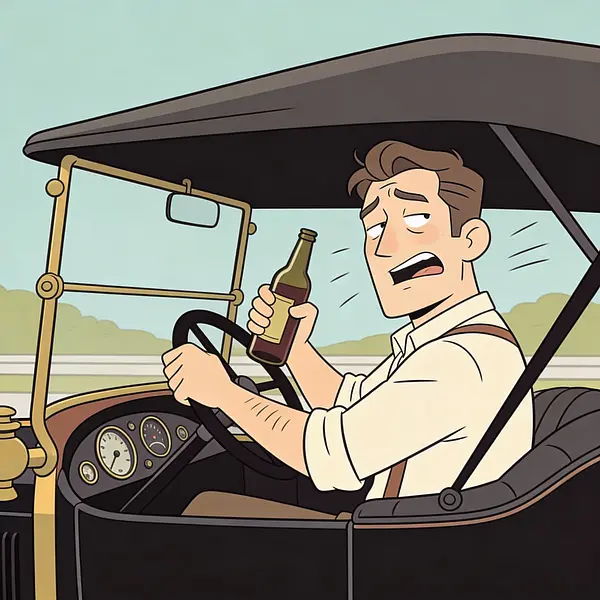
The answer surprises most people. Drunk driving has been illegal in parts of America since 1906, long before breathalyzers existed, before BAC testing was possible, even before most Americans owned cars. But those early laws looked nothing like the complex DUI system we have today.
I have handled thousands of drunk driving cases, both as a prosecutor and as a DUI defense lawyer. I find the evolution of drunk driving laws fascinating. Understanding this history isn’t just interesting trivia. It explains why modern DUI cases are so technical, why defense strategies focus on scientific evidence and procedures, and why a DUI arrest triggers two separate proceedings (criminal court and DMV).
Let’s cover how we got from vague prohibitions on “intoxicated driving” to today’s science-driven, procedure-heavy DUI enforcement system. This history directly impacts how I defend cases today.
Before “DUI,” There Were Drunk Driving Arrests
The drunk driving problem emerged as soon as cars became common. One of the earliest documented drunk driving arrests happened in London in 1897, when police arrested a taxi driver for operating his vehicle while intoxicated.
But in the United States, “DUI” as a defined legal category developed gradually, tied to state motor vehicle codes and eventually federal highway funding incentives. Early lawmakers recognized the danger immediately, even when cars were rare and expensive.
The First U.S. Drunk Driving Laws Were Vague But Important
Early American drunk driving laws bore little resemblance to modern DUI statutes. They typically banned driving “while intoxicated,” without any numeric BAC standard. Testing didn’t exist yet, so prosecutors had to rely entirely on observations.
Two landmark dates in U.S. DUI history
- 1906: New Jersey became one of the first states to specifically criminalize driving an automobile while intoxicated. Keep in mind, this was before most Americans had ever seen a car, let alone owned one.
- 1910: New York enacted one of the earliest comprehensive statutory prohibitions on operating a motor vehicle while intoxicated. Legal scholarship widely cites this as a pivotal early drunk driving law.
Here’s some context for how rare cars were back then:
- 1906: Cars weren’t common on U.S. roads, but lawmakers already understood the danger drunk drivers posed
- 1908: Henry Ford introduced the Model T
- 1910: Mass production of automobiles began
- 1914: The Model T’s price dropped to $490, making cars accessible to working families
- 1920: Over 8 million registered cars in the United States
- 1930: Over 23 million cars on American roads
Think about that. New Jersey passed its drunk driving law when hardly anyone owned a car. That’s how serious lawmakers took the threat.
How Early DUI Cases Were Prosecuted
If you were prosecuted for drunk driving in the early 1900s, the case turned entirely on testimony. Officers described your driving behavior, physical appearance, odor, and speech patterns. Courts had no standardized roadside tests. Prosecutors had no breath machines. No blood tests. No scientific measurements whatsoever.
Defense strategy focused on credibility, alternative explanations, and the complete lack of objective measurement. Sound familiar? Those same strategies still work today when chemical test evidence is weak or missing.
That dynamic changed once medicine and public safety organizations began pushing for measurable standards.
Science Enters the Law: BAC Thresholds Begin to Form
A major turning point came in 1938 when the American Medical Association partnered with the National Safety Council to establish chemical standards for interpreting “under the influence.” They recommended a limit of 0.15% BAC.
Let that sink in. That’s three times the current legal limit for a DWAI in Colorado (0.05%), and nearly double today’s DUI limit (0.08%).
Why This Mattered
This wasn’t yet a nationwide “legal limit,” but it provided a blueprint for future DUI laws. It gave lawmakers and courts a way to connect alcohol concentration to legal definitions of impairment. More importantly, it created the intellectual foundation for “per se” DUI laws decades later, where BAC alone can satisfy an element of the offense.
The concept was revolutionary: you could be guilty of DUI based solely on a number, regardless of how you appeared or drove.
Chemical Testing Technology Transforms DUI Enforcement
Once BAC could be measured reliably, DUI law shifted from subjective judgment toward instrument-based evidence. This fundamentally changed how cases were prosecuted and defended.
Key developments included
- Blood testing for BAC became available in the 1930s
- The Breathalyzer was invented in 1954
- Breath alcohol devices were widely adopted in traffic enforcement by the mid-20th century
- Laboratory blood testing grew as an evidentiary tool
For DUI defense attorneys, this created what I call the “DUI evidence stack”:
- Observations and driving pattern
- Field sobriety testing
- Breath or blood chemical results
- Chain of custody and instrument reliability issues
When breath and blood testing instruments became common, DUI defense work increasingly required technical fluency in instrumentation and testing procedures. That remains absolutely true today. If your lawyer doesn’t understand the science behind these tests, they can’t effectively challenge the results.
Express Consent Laws Reshape the Refusal Landscape
States also built legal tools to obtain chemical evidence, including implied or express consent laws. These frameworks allow license consequences for refusing a lawful chemical test request.
Colorado uses “Express Consent,” meaning that by driving on Colorado roads, you’ve already expressly consented to provide a sample of your breath or blood for chemical testing if lawfully arrested for DUI.
Why Express Consent Changed Everything
Express consent accomplished two things simultaneously:
- It encouraged compliance with chemical testing
- It created a second legal track of consequences, separate from the criminal DUI charge, through administrative license actions
This dual-track system still shapes case strategy today. A drunk driving arrest triggers both criminal court exposure and DMV consequences on different timelines, with different standards and hearing rules.
Through the DMV process: You can lose your license for refusing a chemical test or for driving with a BAC over 0.08%.
In criminal court: You face legal penalties for drunk driving, including up to a year in jail for a first offense in Colorado. A DUI conviction can also revoke your license.
Understanding both tracks is essential for proper DUI defense. Many attorneys miss opportunities at the DMV hearing that could have preserved their client’s driving privileges.
The Federal Government Accelerates Uniformity
DUI is a state crime (unless committed on federal property), but federal action heavily influenced state DUI policy through funding, standards, and highway safety priorities.
A major catalyst was the 1966 Highway Safety Act, which confronted alcohol-impaired driving as a national traffic safety priority. An interesting pattern emerged:
- States create their own criminal law
- Federal policy pushes national consistency by tying certain safety requirements to highway funding
Translation: Although states make their own DUI laws, if they want federal highway funds, they need to fall in line with federal guidelines. It’s a carrot-and-stick approach that’s been remarkably effective at creating nationwide standards.
From “Intoxicated” to “Per Se”: How BAC Limits Became Central
Modern DUI law typically includes multiple offense types:
- Impairment DUI: The government proves your ability to drive was impaired by alcohol or drugs to the slightest degree
- Per Se DUI: The government proves your BAC was at or above a statutory level (usually 0.08%) within a defined timeframe
- DUI: A driver is substantially incapable of operating a vehicle
The per se model spread as states adopted numeric BAC limits, then lowered them over time. The progression typically went from 0.15% to 0.10% to eventually 0.08%.
The Move to 0.08 as the National Norm
The critical legal moment came in 2000 and 2001, when Congress used funding sanctions to accelerate adoption of 0.08% BAC laws. President Clinton’s Transportation Appropriations Bill required states to lower their DUI limits to 0.08% or face denial of federal highway funding.
Every state eventually adopted this standard. By 2004, all 50 states had set their per se BAC limit at 0.08%.
Does the Legal Limit Actually Matter?
I’ll be honest with you. There’s debate about whether lowering legal limits actually saves lives or just creates more prosecutions. Mark Twain famously said there are “lies, damned lies, and statistics.”
Legal limits probably don’t matter much to someone who chooses to drink and drive after consuming 10 beers. They’re not considering whether they’re at 0.04% or 0.079% when they get behind the wheel.
That said, lower limits may have a deterrent effect on repeat offenders or encourage some people to drink in moderation. Hopefully, this saves lives.
What I know from my DUI defense practice: drivers with higher BACs are definitively more dangerous to themselves and others. It’s common to see high BAC results in serious accident cases. Intoxicated driving at any level is a serious safety hazard.
What This Means for DUI Defense
Independent of the legal limit, defense strategy focuses on creating reasonable doubt through other aspects of the case. The fight in a BAC case typically centers on:
- The legality of the stop and detention
- The legality of the arrest
- Chemical test foundation, calibration, maintenance, and operator compliance
- Blood draw procedures, preservatives, contamination risk, and lab methodology
- Rising BAC defenses and time of driving issues
- Medical explanations and measurement uncertainty
This is why “best DUI lawyer” or “DUI attorney near me” searches lead people to attorneys who focus their practice on drunk driving defense. Good DUI attorneys can argue both constitutional issues and forensic details.
The Modern DUI Era: Data, Deterrence, and Technology
DUI law kept expanding beyond BAC limits. Policy now targets enforcement certainty and prevention tools, including ignition interlock devices, high-visibility enforcement campaigns, and administrative sanctions.
Drunk driving remains a major factor in traffic fatalities. NHTSA reports that approximately 30% of U.S. traffic crash fatalities involve drunk drivers with BACs of 0.08% or higher. In 2023 alone, 12,429 people were killed in drunk driving crashes.
State legislatures didn’t stop at making DUI illegal. They instituted systems to educate and deter drunk driving behavior. In Colorado, a DUI or DWAI conviction requires:
- Alcohol education and therapy as required by an alcohol evaluator
- Community service
- Probation
- Fines
- Possible jail time (mandatory for prior convictions or BAC over 0.20%)
So When Did DUI Actually Become Illegal?
Here’s the complete timeline:
- Early 1900s: Drunk driving became illegal in parts of the United States through state statutes prohibiting driving while intoxicated, with New Jersey (1906) and New York (1910) as early examples.
- Late 1930s: DUI became “modern DUI” once chemical standards and BAC concepts entered the legal system, especially after national organizations promoted measurable thresholds.
- 1954: The Breathalyzer was invented, revolutionizing enforcement.
- 2000-2004: DUI became nationally standardized at 0.08% after federal funding sanctions drove state adoption, with universal 0.08% state limits by 2004.
That’s the real evolution: from a vague prohibition on “intoxicated driving” to a science-driven, procedure-heavy system built around chemical proof.
Colorado DUI Law: A State-Specific History
Since I practice in Colorado, let me give you our state’s specific timeline:
- Early 1900s: Colorado criminalized impaired driving shortly after cars appeared on Colorado roads, following national trends.
- 1982: Major DUI statute rewrite. Colorado enacted comprehensive reforms that revised and strengthened DUI/DWAI laws, requiring better records, new penalties, and alcohol abstinence conditions for repeat offenders.\
- 1990s-2000s: Colorado aligned with national BAC standards, adopting 0.08% per se DUI laws. Modern Colorado law (C.R.S. § 42-4-1301) also includes a 0.05% presumptive limit for impaired driving (DWAI).
- 2013: Colorado passed House Bill 2013-1325, amending DUI statutes including definitions and penalties.
- 2015: Fourth DUI became a felony. Colorado lawmakers changed the law so a fourth DUI conviction automatically becomes a class 4 felony, significantly increasing penalties for repeat offenders.
- 2019: Tandem DUI per se law added. Colorado created a new offense for driving with both alcohol and measurable drugs in your system.
What Is Tandem DUI?
Tandem DUI applies when a driver is suspected of using alcohol and one or more drugs “in tandem.” The slang term “cross-faded” (drunk and high simultaneously) perfectly describes when someone might face a tandem DUI charge.
The legal definition requires:
- Evidence based on demeanor, behavior, and observable impairment that the driver consumed alcohol or drugs (or both)
- The driver was substantially incapable mentally or physically to exercise clear judgment or safe operation
- Any measurable amount of a drug or controlled substance (other than alcohol) in blood or oral fluid at the time of driving or within four hours after
How Does DUI History Inform Defense Today?
Understanding this legal evolution directly impacts how I defend DUI cases:
- Scientific evidence, not just officer opinion: Modern cases require challenging the science, not just the observations.
Administrative license rules, not just the criminal case: You must fight on both fronts to protect your client’s driving privileges. - Statutory technicalities: Observation periods, admissibility foundations, and test timing rules all stem from this historical development.
- Constitutional limits: Protections against unreasonable stops, searches, and compelled testing remain your strongest defenses.
What Good DUI Representation Requires
Your lawyer should be able to do three things clearly:
- Explain the legal theory: Impairment DUI vs. per se DUI, and why it matters in your case
- Attack the process: Challenge the stop, arrest, test request, testing method, and documentation
- Interpret the science: Understand breath and blood measurement limits, lab practices, and alternative explanations
This is why experience matters in DUI defense. The law has evolved over more than a century, creating layers of complexity that require specialized knowledge to navigate effectively.
If You Have been Charged with a DUI
DUI laws started simple and became increasingly complex as science, technology, and policy evolved. What began as a basic prohibition on intoxicated driving transformed into a sophisticated system involving chemical testing, administrative hearings, federal funding mandates, and felony enhancements.
This complexity creates opportunities for defense. Every layer of procedure, every scientific test, every administrative requirement represents a potential weakness in the prosecution’s case if not followed correctly.
If you’re facing DUI charges in Colorado Springs, you need an attorney who understands not just current DUI law, but how we got here and why these procedures exist. That knowledge is the foundation of effective defense strategy.
Contact The McDowell Law Firm today for a free consultation. We’ll evaluate your case and explain exactly how the law applies to your situation. Remember, being charged with DUI doesn’t mean you’re guilty. Make the State prove their case according to the rules that a century of legal evolution created to protect you.
The post When Did DUI Become Illegal? The Surprising History of Drunk Driving Laws in America first appeared on McDowell Law Firm.
from McDowell Law Firm https://mcdowellfirm.com/when-did-dui-become-illegal/
https://mcdowellfirm.com/practice-area/dui-defense/

No comments:
Post a Comment